Please Choose Your Language


Views: 0 Author: Site Editor Publish Time: 2026-07-18 Origin: Site


Selecting the exact right mixing vessel dictates your entire facility's production efficiency. Plant managers must constantly balance heavy capital expenditures against desired process yields. Over-specifying your processing equipment drains limited engineering budgets needlessly. Conversely, under-specifying your vessels causes rapid product spoilage, severe mechanical fouling, and drastically extended batch times. You often face a tough choice between a basic unheated unit ideal for ambient liquids, and a highly engineered system built for complex, temperature-sensitive formulations. This guide provides a skeptical, engineering-first comparison of these two distinct vessel types. We will thoroughly explore thermal management requirements, complex fluid dynamics, and hidden facility implementation risks. You will finally learn how to match your precise equipment specifications directly to your daily production realities.
Engineers consider standard unjacketed vessels the foundational workhorses of fluid processing. They feature straightforward designs devoid of complex thermal management systems. You will typically find them relying on standard axial or radial impellers. These traditional agitators generate basic fluid motion suitable for straightforward blending tasks.
You achieve optimal success using a single-layer mixing tank during high-volume, low-viscosity applications. Thermal transfer holds no relevance in these specific scenarios. Simple aqueous solutions, diluted cleaning chemicals, and basic beverage storage represent perfect use cases. The equipment quickly homogenizes miscible fluids. It does so without requiring external energy inputs beyond the primary motor.
However, these baseline models carry distinct limitations. Their absolute lack of temperature control restricts phase transitions. You cannot use them for melting solid waxes or solid fats into liquid states. They also struggle heavily during complex emulsion processes. High-shear mixing generates internal friction heat. Without cooling jackets, this friction degrades sensitive ingredients. Furthermore, complex mixtures remain highly prone to stratification in unbaffled, standard tanks.
The core advantage lies in the cost reality. These units remain highly cost-effective upfront. They demand a minimal maintenance footprint over their lifespan. You do not need to inspect pressure jackets or replace thermal seals. Facilities save substantial capital when simple blending represents the only process requirement.
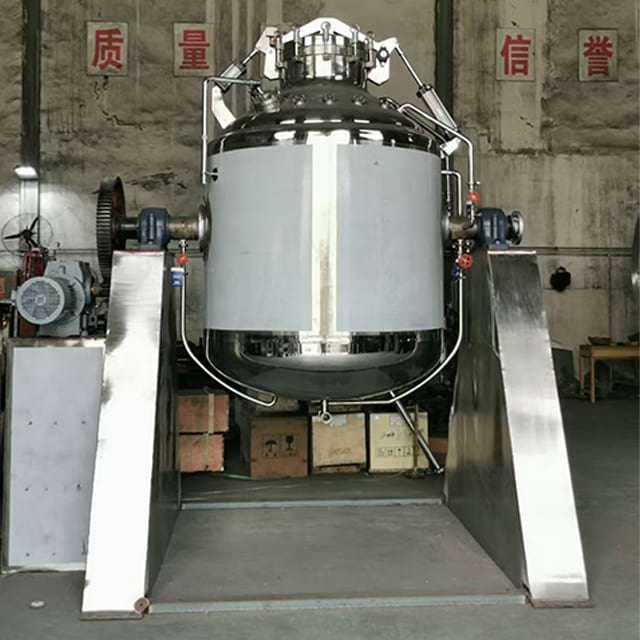
Advanced chemical and cosmetic formulations require significantly more than simple agitation. They demand strict environmental control. A rotating heating mixing tank provides this control through sophisticated mechanical and thermodynamic engineering. The design directly addresses the physical challenges of processing thick, heat-sensitive materials.
Thermal management serves as the primary differentiator. Manufacturers circulate steam, hot water, or thermal oil through external jackets. These jackets wrap around the primary inner vessel. Operators induce precise temperature changes by regulating the utility flow. Dimple jackets efficiently handle steam pressure, while half-pipe coil jackets excel at high-flow liquid heating. This localized heating reduces fluid viscosity rapidly.
Rotational wall scraping solves a critical thermodynamic problem. Heated walls cause stagnant materials to scorch. Engineers implement Teflon (PTFE) scrapers attached to the outer rotating agitator. These scrapers continuously press against the heated inner walls. They physically strip away the thin boundary layer of fluid. This continuous renewal prevents product degradation and burn-on. It also dramatically increases the overall heat transfer coefficient.
Complex fluid dynamics govern the internal environment. Engineers frequently deploy counter-rotating agitators within these vessels. A central turbine pushes material downward, while the outer scraper frame pulls it upward. This creates specialized flow patterns. The system easily handles variable Reynolds numbers. It homogenizes high-shear requirements without leaving unmixed dead zones in the batch.
Comparing these vessels requires looking past their initial purchase prices. You must map their mechanical features directly to tangible business outcomes. The following chart breaks down the fundamental performance differences.
Vessel Capability Comparison Summary
| Performance Metric | Standard Single-Layer Tank | Rotating Heating Tank |
|---|---|---|
| Viscosity Limit | Low (< 5,000 cP) | Extremely High (> 100,000 cP) |
| Thermal Control | None (Ambient only) | Precise (Heating & Cooling) |
| Agitation Style | Simple Axial/Radial | Complex Counter-Rotating & Scraping |
| Utility Requirements | Electrical only | Electrical, Steam, Chilled Water |
| Burn-on Risk | N/A (No heat applied) | Mitigated by PTFE scrapers |
Standard tanks fail rapidly when fluid viscosity exceeds a few thousand centipoise (cP). Their simple impellers simply carve a hole in thick pastes. The surrounding material remains completely stationary. If operators force the process, the thick fluid overloads the agitation motors. This triggers electrical faults and halts production.
Conversely, applied heat actively lowers material viscosity. A heating mixing tank warms thick gels, syrups, and heavy waxes until they flow easily. The rotating agitators then efficiently homogenize these softened materials. This rheological shift allows you to process previously unworkable compounds.
Utility infrastructure heavily dictates your facility readiness. Standard tanks only require standard electrical power. You connect the primary agitation motor to your grid, and production begins immediately. The energy footprint remains remarkably low and entirely predictable.
Advanced heated units demand significant auxiliary utility support. You must pipe in industrial boilers or steam generators to heat the jacket. You often need adjacent cooling towers or chillers to rapidly drop batch temperatures later. These heavy utility draws require larger facility footprints and higher monthly energy budgets.
Sanitation protocols differ drastically between the two designs. For a standard vessel, simple spray-ball CIP is usually sufficient. A static spray ball rinses ambient, low-viscosity residues down the central drain quickly. You face very few hidden crevices.
Heated units introduce distinct cleaning challenges and surprising benefits. Scraping mechanisms and localized heating surfaces require more rigorous CIP protocols. You must ensure cleaning fluids reach behind the scraper blades. However, the physical scraping action prevents baked-on residue during production. This reduction in heavily carbonized waste actually accelerates the final cleaning cycles for heavy materials.
Adopting complex process equipment introduces subtle engineering risks. Facility managers often encounter unexpected hurdles during installation. Demonstrating caution prevents expensive retrofit delays later.
Over-specifying equipment represents the most common procurement error. Engineers sometimes purchase a complex heated vessel for a problem easily solved by simple pump-circulation mixing. If you only need to blend moderate-viscosity liquids, mechanical agitation might be overkill. A simple external circulation loop often achieves homogeneous blending at a fraction of the cost.
Utility mismatch frequently halts commissioning. You might purchase a jacketed tank only to realize your facility steam pressure falls short. The thermal oil flow rates must precisely match the new vessel's heat transfer area (HTA). If your existing boiler produces insufficient BTUs, the tank will never reach its target process temperature. You must rigorously audit your utility baseline before ordering.
Baffle complications introduce severe engineering headaches. Standard tanks rely heavily on stationary wall baffles to disrupt fluid swirling. However, installing baffles inside a rotating scraper tank creates geometric conflicts. The scrapers must sweep the walls clean, leaving no room for traditional baffles. Removing baffles increases the risk of deep vortexing. Manufacturers must design specialized internal stators to resolve this, complicating your cleaning validation protocols.
Choosing the correct equipment requires aligning your budget with your physical chemistry requirements. Use the following framework to finalize your engineering specifications.
When to buy Standard:
When to buy Rotating/Heating:
Neither mixing vessel ranks as objectively superior to the other. They simply serve completely different fluid dynamics and thermal realities. Standard units excel at cheap, rapid blending of simple fluids. Heated, scraping units tackle the heavy, temperature-sensitive formulations that would destroy basic equipment.
Your immediate next step involves precise mathematical auditing. You should calculate your formulation's maximum dynamic viscosity at your target processing temperatures. Simultaneously, audit your existing utility infrastructure. Map your boiler capacity and cooling tonnage. Once you define these exact physical boundaries, you can confidently engage a manufacturer for accurate custom fabrication quotes.
A: Generally no. Welding an aftermarket jacket onto a standard tank immediately compromises pressure vessel certifications. The intense welding heat alters the existing structural integrity. Furthermore, the retrofitted tank still lacks the necessary internal scraping agitation to prevent localized product burning against the newly heated walls.
A: It depends on your fluid viscosity and agitation speed. For highly viscous materials, wall scrapers actively push material toward the center, rendering baffles unnecessary. For lower viscosities, baffles may still be required to prevent a deep central vortex. However, combining them complicates the scraper frame design.
A: For certain moderate-viscosity fluids, recirculating the product through an external heat exchanger easily substitutes for a jacketed tank. It saves substantial upfront costs. However, external circulation struggles heavily with high-particulate mixtures or shear-sensitive materials. These delicate compounds require gentle, in-tank scraping rather than high-velocity pump impellers.