Please Choose Your Language


Views: 0 Author: Site Editor Publish Time: 2026-09-11 Origin: Site


High-viscosity materials present severe flow resistance during processing operations. Operators frequently struggle with heavy resins, thick cosmetic creams, and dense food syrups. These demanding substances cause standard mixers to stall completely. Standard impellers leave large unmixed dead zones inside the vessel. They also degrade sensitive products through excessive shear forces. Managing these thick materials requires a highly synchronized approach to both thermal dynamics and fluid mechanics. You cannot rely on brute mechanical force alone. Instead, you must strategically manipulate the material's physical properties while it blends. An Electric Heating Mixing Tank solves this complex issue efficiently. It utilizes controlled jacketed heat to lower the fluid viscosity safely. This steady thermal action pairs directly with specialized high-torque agitation. Together, they ensure uniform blending without causing localized scorching or catastrophic motor failure. In this guide, we will explore exactly how these specialized tanks conquer thick fluids and optimize your daily production lines.
Viscosity Reduction: Electric heating jackets (often using thermal oil or water) provide uniform heat transfer, safely reducing material resistance before and during agitation.
Agitator Selection is Critical: Standard impellers fail in thick fluids; success relies on anchor or scraper blades within the Stirring Mixing Tank to physically move heavy mass and prevent burn-on at the tank walls.
Torque Over Speed: Processing high-viscosity materials requires high-torque, low-speed gear drives rather than high-speed motors to prevent mechanical stalling.
Risk Mitigation: Careful specification of temperature controllers, scraper materials (e.g., PTFE), and motor sizing prevents product degradation and equipment downtime.
Processing thick fluids introduces unique mechanical and thermal hurdles. Standard mixing equipment typically relies on turbulent flow to blend liquids quickly. However, high-viscosity materials exist almost exclusively in the laminar flow regime. They inherently resist movement and absorb applied kinetic energy rapidly.
Flow Resistance & Stagnation: Viscous fluids absorb mechanical energy immediately upon contact with the blade. This absorption strictly limits the radius of active flow around a standard mixing impeller. Consequently, standard equipment creates stagnant, unmixed "dead zones" near the tank walls. You cannot simply spin a blade faster to fix this stagnation. High-speed rotation in thick fluids only cavities the center while leaving the perimeter completely untouched.
The Heat Transfer Problem: Thick materials act as exceptionally poor thermal conductors. They lack the natural convection currents found in watery liquids. Applying heat too quickly from the tank wall causes rapid localized scorching. Engineers call this phenomenon thermal fouling. While the exterior product burns against the hot steel, the center of your batch remains dangerously cold and thick.
Mechanical Strain: High flow resistance causes severe mechanical stress throughout the entire machine. Agitator shafts, mechanical seals, and drive motors endure extreme rotational forces. This intense friction frequently leads to premature equipment failure if you specify the wrong hardware parameters during the design phase.
Operators must recognize these physical limitations early. Attempting to force heavy pastes through standard impellers always results in poor product quality. You must address the thermal conductivity and the mechanical flow simultaneously to achieve success.
Overcoming the limitations of heavy fluids requires specialized intervention. You must break down the material's internal resistance before applying heavy shear forces. A dual-action approach combines gentle thermal conditioning with deliberate physical movement.
Jacketed electric heating systems deliver precise thermal energy directly to thick materials. Industrial heating elements submerge into a transfer medium contained within the tank jacket. Operators typically utilize engineered thermal oil or treated water for this specific purpose. The fluid-filled jacket provides indirect, highly uniform heat distribution across the entire vessel surface. This steady application of thermal energy begins to lower the material's viscosity safely. The exterior layers gradually transition into a pumpable, mixable state without burning.
Once the boundary layer viscosity drops sufficiently, the Stirring Mixing Tank mechanism actively engages. Continuous rotational movement physically replaces the heated boundary fluid. Cooler, thicker core fluid constantly takes its place against the hot jacket walls. This synchronized integration maximizes overall thermal efficiency. It forces artificial convection within a fluid that naturally resists it. By constantly sweeping the heated surface, the equipment actively prevents product degradation while accelerating the total batch heat-up time.
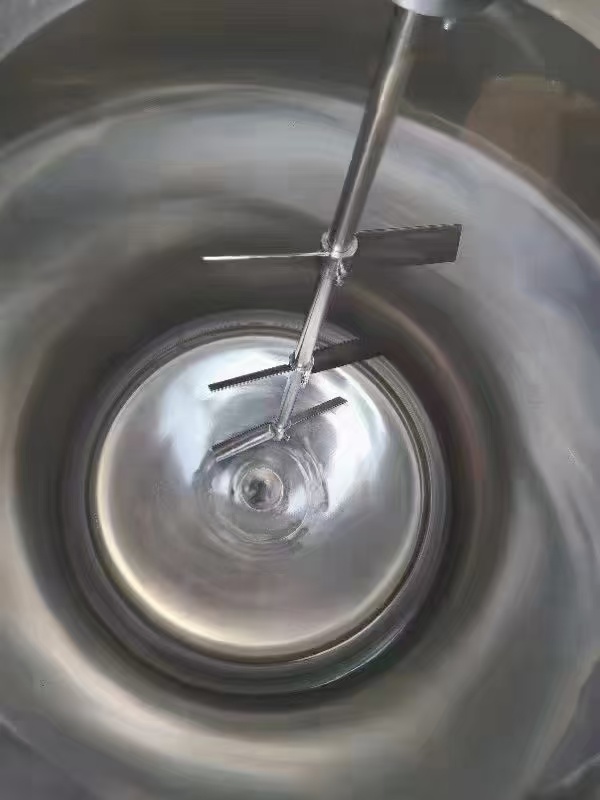
Standard marine propellers or pitch-blade turbines fail miserably in heavy pastes. They simply bore an empty hole through the center of the thick mass. To handle high viscosity effectively, you need specialized impeller geometries engineered for maximum surface contact.
Anchor Agitators: These robust blades mimic the internal contour of the vessel. They provide extremely close clearance to the tank walls and the bottom dish. As they rotate slowly, they physically push the heavy mass outward. This action promotes critical radial flow. Standard impellers simply cannot achieve this sweeping movement. Anchor designs excel at moving the entire batch as a single cohesive unit.
PTFE Wall Scrapers: These specialized additions are absolutely crucial for electric heating applications. Hinged scrapers attach directly to the outer edges of the anchor blade. Centrifugal force pushes them outward. They physically scrape the heated boundary layer off the inner tank wall continuously. This persistent scraping action prevents burn-on completely. It also dramatically improves heat transfer rates into the cooler core mass by constantly exposing fresh product to the heated steel.
Counter-Rotating Dual Agitation: You need this advanced design for extreme viscosities. An outer anchor blade rotates slowly in one direction to sweep the walls. Simultaneously, a central high-shear turbine rotates rapidly in the exact opposite direction. They work together in perfect harmony. The outer blade feeds heavy material directly into the inner high-speed shearing zone. This configuration processes the toughest, stickiest materials available in industrial manufacturing.
Selecting the right blade geometry dictates the entire success of your batch. You must match the impeller style to your specific fluid's rheology to prevent structural stalling.
Procuring the correct vessel requires meticulous engineering calculations. You cannot guess the required specifications when dealing with heavy polymers or dense food products. Precision ensures continuous operation and protects your facility from catastrophic breakdowns.
Sizing the drive system demands careful foresight. You must base the motor and gearbox torque strictly on the material's maximum starting viscosity. Materials are always thickest in their cold state. Never base your motor size on the operating, heated viscosity. If the motor lacks sufficient torque to initiate movement in a cold batch, the entire system stalls immediately.
Evaluating the electrical heating requirements depends directly on your target heat-up times. Engineers must size the total kilowatt (kW) rating carefully. More importantly, they must calculate the watt density of the individual heating elements. High watt density causes the thermal fluid to degrade or carbonize rapidly. You need sufficient overall power distributed over a large surface area to ensure gentle, sustained heating.
Multi-point temperature sensors remain an absolute necessity for quality control. They measure both the circulating jacket fluid and the internal product mass independently. You must connect these dual sensors to an advanced PLC or PID controller. This closed-loop communication strictly avoids overshooting your target temperatures. The system automatically dials back the heating elements as the core product approaches the desired setpoint.
Evaluation Parameter | Standard Fluid Processing | High-Viscosity Processing |
|---|---|---|
Motor Torque Sizing | Based on operating temperature viscosity | Based strictly on cold-start maximum viscosity |
Agitation Speed | High-speed direct drive (1500+ RPM) | Low-speed gear reduction (10 - 60 RPM) |
Heating Control | Single sensor monitor | Dual-sensor PID loop (Jacket + Product) |
Wall Clearance | Wide gap acceptable | Close clearance with active PTFE scraping |
Surface Finish Compliance | Standard mill finish (Chemicals) | Ra < 0.8 μm sanitary finish (Food/Pharma) to prevent sticking |
Finally, material compliance dictates your construction standards. Selecting 304 versus 316L stainless steel depends on the product's corrosiveness. Furthermore, high-viscosity materials tend to stick aggressively to rough surfaces. Sanitary surface finishes, measured in precise Ra values, help mitigate this adhesion. Smoother internal finishes significantly improve product yield and simplify the sanitation process.
Deploying heavy-duty mixing equipment introduces distinct operational realities to your facility. You must prepare your infrastructure and your maintenance teams for the unique demands of viscous processing.
Electric heating elements require significant electrical amperage, especially during initial startup phases. Facilities must verify their existing electrical infrastructure capacity before installation. Drawing massive power to heat heavy thermal oil can easily overwhelm older electrical panels. Ensure your facility possesses the appropriate three-phase power supply required to run both the large gearboxes and the high-draw heating banks simultaneously.
Cleaning presents another substantial daily hurdle. High-viscosity materials are inherently difficult to wash away. They cling stubbornly to every internal crevice. You must evaluate the tank geometries carefully during the design phase. Conical bottom shapes often drain thick pastes much better than standard dished bottoms. Furthermore, the inclusion of dedicated CIP (Clean-in-Place) spray balls requires specific attention. Standard static spray balls lack the force to remove heavy resins. You must implement high-impact, rotary jet heads to blast away sticky residues effectively.
Viscous, heated environments drastically accelerate wear on moving components. Standard mechanical lip seals fail rapidly under these harsh conditions. Heated polymers, heavy glues, or thick syrups will destroy basic packing materials in days. Engineers highly recommend specifying double mechanical seals equipped with dedicated cooling liquid loops. These advanced barrier seals actively prevent internal leakage. They also block external atmospheric contamination from ruining your high-value batches.
Processing thick, resistant materials effectively requires matching thermal input with purpose-built mechanical agitation. You simply cannot force heavy fluids to blend using standard high-speed methods. Addressing flow stagnation and poor thermal conductivity demands a synchronized, engineered solution.
The final decision logic remains clear. An Electric Heating Mixing Tank equipped with active scraper agitation and heavy-duty torque is the verifiable standard. It successfully eliminates stagnant dead zones. It completely prevents localized product scorching through continuous wall sweeping.
Buyers should take concrete next steps before finalizing specifications. First, conduct a physical pilot test using your exact viscous material. Second, utilize that test data to calculate your required cold-start motor torque and target heat-up times accurately. Finally, verify your optimal blade configuration to guarantee seamless integration into your production workflow.
A: It depends heavily on the specific agitator design and the motor size. However, when equipped with counter-rotating dual-agitation and active PTFE wall scrapers, these heavy-duty vessels can easily process extremely thick materials well over 100,000 centipoise (cps).
A: Thermal oil can safely reach much higher operating temperatures, often up to 300°C. It achieves this extreme heat without generating the dangerous internal physical pressures typically associated with high-temperature pressurized water or live steam.
A: Yes. A VFD allows operators to start the mixing process safely at very low speeds while the material remains cold and highly resistant. Operators can then gradually increase the rotational speed as the applied heat slowly reduces the fluid's overall viscosity.