Please Choose Your Language


| Quantity: | |
|---|---|


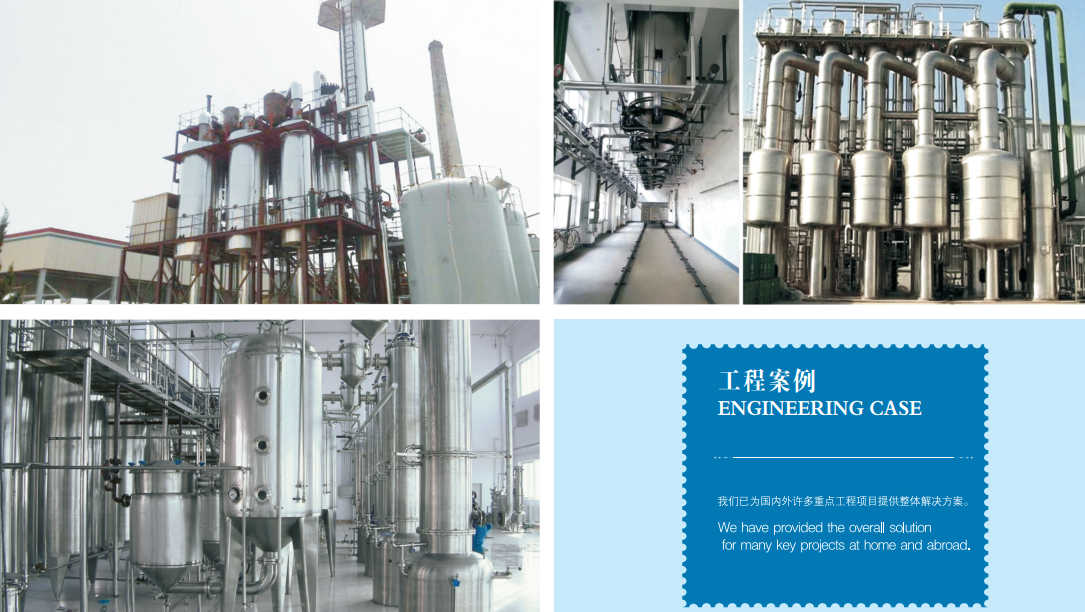
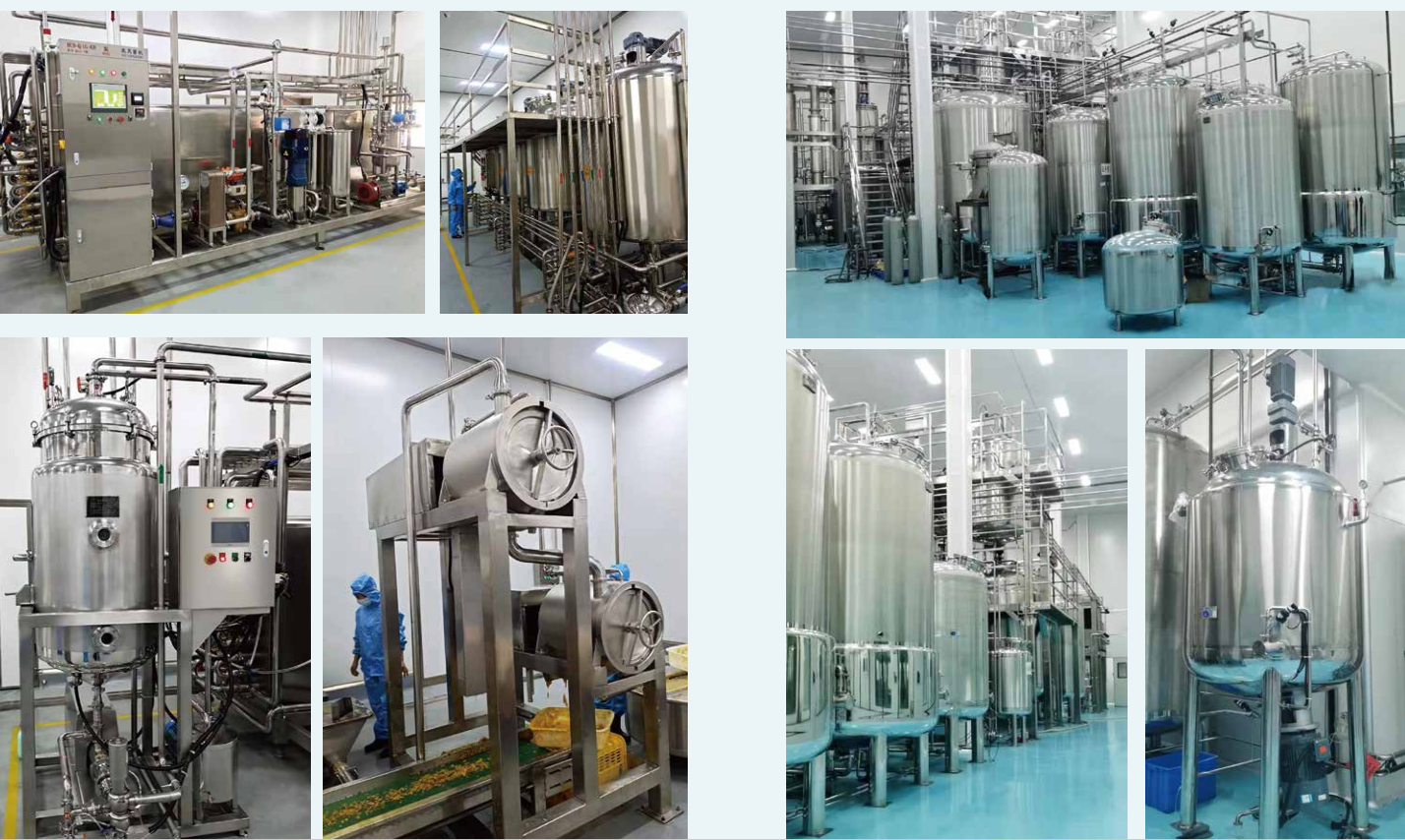
Stainless steel tanks possess two core properties: corrosion resistance to atmospheric oxidation (known as "stainlessness") and durability against corrosive media such as acids, alkalis, and salts. Widely utilized in chemical, pharmaceutical, petroleum, dye, textile, and food processing industries, these tanks are ideal for storing a diverse range of corrosive liquid solutions.
These versatile tanks serve as liquid storage tanks, mixing tanks, temporary storage tanks, and water storage tanks. They are indispensable equipment for manufacturers in the dairy, beverage, food, pharmaceutical, and chemical industries. Primarily, they efficiently blend and homogenize milk, sugar, and various other ingredients, ensuring uniform product consistency.
· Integrated Design: Combines heating and stirring functions into a single unit, saving floor space, eliminating the complexity of using separate equipment, and significantly boosting production efficiency.
· Uniform Heating: Equipped with either jacket heating or electric heating, the system ensures uniform heat distribution without local overheating. This guarantees stable material quality and prevents product deterioration.
· Efficient Mixing: Features multiple impeller types (paddle, anchor, helical) with stepless speed regulation, accommodating materials of varying viscosities for thorough mixing without residue.
· Energy Saving & Eco-Friendly: Boasts high heating efficiency with low energy consumption. An optional thermal insulation layer further reduces heat loss, lowering operational costs.
· Clean & Compliant: All wetted parts are constructed from food-grade SUS304/SUS316L stainless steel. The inner wall is mirror-polished to eliminate dead corners, ensuring easy cleaning and compliance with industry hygiene and safety standards.
· Stable & Durable: Engineered with a robust structure and high-quality components, the tank features a low failure rate, is easy to maintain, and has a service life of over 10 years.
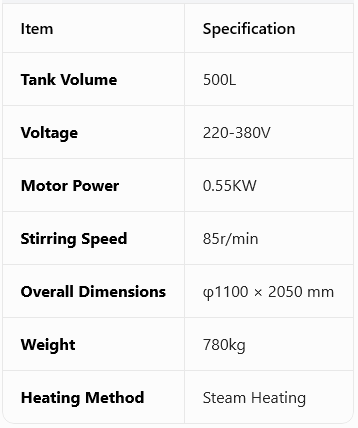
· Construction: Available in single-layer, double-layer, or triple-layer stainless steel structures.
· Material: All materials are food-grade stainless steel, ensuring safety and purity.
· Design: Features a user-centric design for high operability. The inner wall transition sections adopt arc smoothing to guarantee hygienic, dead-free zones.
· General Standards: ISO 9001 Quality Management System, GB 150-2011 "Pressure Vessels" Standard.
· Food Industry: GB 4806.1-2016 "General Safety Requirements for Food Contact Materials and Products".
· Biopharmaceutical Industry: GMP ("Good Manufacturing Practice") Guidelines.
1. Quick-opening manhole.
2. Various types of CIP cleaning devices.
3. Insect-proof hygienic air breather.
4. Adjustable legs with casters.
5. Removable feeding pipe kit.
6. Thermometer (customizable upon request).
Q: What are the differences between jacket heating and electric heating, and how do I choose?A: Jacket heating is ideal for large-scale production, offering uniform heating and low energy consumption, making it suitable for materials requiring constant temperature. Electric heating, on the other hand, is flexible and convenient, best suited for small-scale production or sites without steam supply.
Q: Is the equipment easy to clean and maintain?A: Yes. The mirror-polished inner wall eliminates dead corners for effortless cleaning. An optional CIP (Clean-in-Place) system enables automated cleaning without manual disassembly. Routine maintenance involves simple inspections and cleaning, with low complexity.
Q: What is the service life of this equipment?A: Under normal use and maintenance, the service life can exceed 10 years. Selecting appropriate materials and adhering to operational guidelines can further extend this lifespan.
Q: Can it be equipped with an automatic control system?A: Absolutely. It can be integrated with a PLC automatic control system to enable intelligent regulation of temperature, stirring speed, and operating hours .