Please Choose Your Language


Views: 0 Author: Site Editor Publish Time: 2026-09-14 Origin: Site


Mismatching process equipment ruins batches and degrades valuable materials. It also breaks expensive machinery. You must align your hardware to your raw materials carefully. An Electric Heating Mixing Tank integrates heating elements directly into a thermal fluid jacket. It provides precise, localized temperature control. It skips the need for external steam boiler infrastructure entirely. This self-contained heating method transforms raw ingredient blending. This article provides an evidence-based evaluation framework. You will learn how to determine if this tank configuration aligns perfectly. We will evaluate material rheology, thermal needs, and your production scale. Understanding these principles ensures smooth daily operations. It protects your product quality consistently.
Material Versatility: Ideal for medium-to-high viscosity fluids, temperature-sensitive formulations, and phase-change materials (e.g., waxes to liquids).
Heating Precision: Electric heating offers exact temperature control, preventing "burn-on" for delicate materials common in food, cosmetics, and pharmaceuticals.
Agitation Matching: Processing success depends not just on the tank, but on matching the agitator type (anchor, high-speed dispersion) to the material's specific gravity and viscosity.
Cost-to-Value: Best suited for facilities requiring high thermal precision but lacking existing industrial steam boiler infrastructure.
Electric heating solves complex processing challenges across multiple industries. Different material classes demand specific thermal profiles. We will explore exactly why electric jackets excel for these groups.
You will frequently process lotions, creams, ointments, and shampoos. These fluids require gentle, sustained heat. Steady heat maintains target viscosity during emulsification. Gentle heating prevents degradation of active pharmaceutical ingredients (APIs). It also protects delicate surfactants. High-viscosity emulsions easily separate if the temperature fluctuates wildly. An electric jacket maintains a highly stable thermal curve. The system applies energy evenly across the entire surface area. Formulators rely on this stability to lock in emulsion phases. You avoid creating separated layers in the final retail product. Stable batches improve overall yield tremendously.
Food production involves syrups, chocolates, sauces, and edible oils. Electric jacketed heating prevents localized hot spots. This design eliminates sugar caramelization. It stops thermal degradation, often called burn-on, along inner vessel walls. Smooth heat transfer ensures consistent flavor profiles. It protects the nutritional integrity of delicate ingredients. Chocolatiers temper cocoa butter meticulously using these precise thermal controls. Sauce manufacturers prevent sugar burning during reduction phases. Operators clean the vessels much faster because ingredients do not scorch.
Industrial processes handle waxes, resins, polymers, and heavy greases. These remain completely solid at room temperature. They require reliable, high-temperature bands continuously. You must melt them and maintain a liquid state. This enables effective chemical compounding. It allows high-speed dispersion of powders into the liquid matrix. Adhesives manufacturing demands constant heat to keep tackifiers flowing properly. Resin producers rely on jacket heat to drive chemical reactions. Electric elements deliver this high-grade heat reliably. They sustain the required temperatures for many hours.
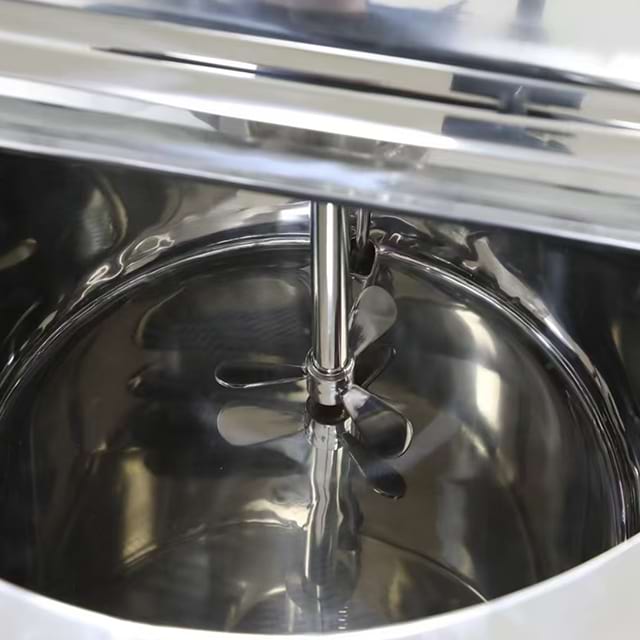
Buyers must shortlist the right heating method carefully. Your specific material dictates this crucial choice. Let us compare the operational realities between these two systems.
Electric heating provides superior gradual temperature accuracy. This proves ideal for processing delicate materials safely. The system regulates thermal oil temperature incrementally. Thermocouples monitor the bath constantly. Steam offers faster heat-up times generally. Operators use steam for high-volume, robust materials mostly. These materials tolerate rapid thermal shocks well. Sensitive polymers degrade under flash steam heat. Electric systems gently raise the batch temperature instead.
Electric heating tanks act as self-contained systems. They offer a simple plug-and-play setup. This makes them optimal for isolating specific material batches. You do not need a central facility boiler. You bypass complex piping and boiler compliance checks entirely. Steam requires extensive insulated pipe runs across your factory. Steam traps require constant maintenance and monitoring. Electric systems sit independently on the production floor.
You must compare safe upper temperature limits directly. Thermal oil safely reaches very high temperatures easily. Typical synthetic thermal oils exceed 300°C. Pressurized steam systems require heavy-duty pressure vessels for similar temperatures. High-pressure vessels trigger strict safety regulations. High-melting-point materials favor electric thermal oil jackets. They keep system pressure low and exceptionally safe.
Heating Method Compatibility Chart
Evaluation Metric | Electric Heating (Thermal Fluid) | Steam Heating |
|---|---|---|
Temperature Precision | Very High (Gradual control) | Moderate (Rapid fluctuations) |
Heat-Up Speed | Moderate to Slow | Very Fast |
Infrastructure Required | Electrical power source only | Industrial boiler and complex pipework |
Best Material Match | Delicate, phase-change, high-viscosity | Robust, low-viscosity, high-volume |
System Pressure | Low (Atmospheric to mild pressure) | High (Requires certified pressure vessels) |
Processing success demands configuring your Mixing Tank correctly. You must select the right agitation mechanism always. Material viscosity dictates the ideal impeller style.
Engineers specify anchor agitators for high-viscosity materials. These handle thick creams and heavy sauces efficiently. Teflon scrapers prevent material buildup on heated tank walls. Clean walls ensure even heat transfer continuously. Scrapers constantly fold the heated boundary layer back into the batch. This prevents localized scorching near the metal surface. High-viscosity gels rely heavily on this sweeping action.
Some applications require rapidly integrating dry powders into liquid bases. You might mix fine pigments into heavy resins. You could blend thickeners into liquid food bases. High-speed dispersion blades create high shear zones. They break down agglomerates quickly under heated conditions. The saw-tooth blade acts like a milling tool. It tears apart stubborn clumps effectively.
These mixers suit low-viscosity, miscible liquids perfectly. Such fluids require rapid turnover and thermal homogenization. Examples include clear beverages or light chemical suspensions. They promote vigorous axial or radial flow patterns. Turbines push fluids outward toward the heated jacket. Propellers push fluids downward to sweep the tank bottom. Both styles eliminate thermal stratification efficiently.
Agitator Selection Steps:
Measure the specific gravity of your raw ingredients accurately.
Determine the peak viscosity during the material cooling cycle.
Match the impeller shape to the required fluid flow pattern.
Add wall scrapers if the material coats the vessel walls.
Verify clearance between the impeller and the tank bottom.
Procurement decisions require a rigorous, compliance-aware framework. Focus on material compatibility and facility safety closely.
You must build a decision matrix for stainless steel alloys. Standard 304 stainless steel handles mildly corrosive fluids well. Upgrading to 316L stainless steel provides superior resistance always. Industry standards often dictate 316L for high acidity environments. FDA and cGMP guidelines heavily favor 316L for sanitary applications. Chlorides pit standard 304 steel rapidly under heat. Ensure your engineers review the chemical makeup beforehand.
Evaluate dimple jackets against conventional jackets carefully. Dimple jackets handle thermal fluid circulation very well. They manage pressure effectively while reducing vessel weight. You must also assess outer insulation thickness. High-quality mineral wool insulation protects operators from radiant heat. It keeps thermal energy directed inward toward the batch. Poor insulation wastes electrical energy quickly. It overheats your production floor simultaneously.
Calculate power requirements based on material specific gravity. Peak viscosity usually occurs during the cooling cycle. Fluid thickens as the internal temperature drops. The gearbox must deliver sufficient torque safely. An undersized motor will stall or fail completely. High torque drives handle non-Newtonian fluids effortlessly. Variable frequency drives (VFD) allow operators to adjust speeds safely.
Pharmaceutical and food processors require strict sanitary controls. You must evaluate internal surface finishes stringently. Specify desired Ra values for absolute smoothness. Mirror polishing eliminates microscopic pits. Ensure clean-in-place (CIP) compatibility through spray balls. Smooth continuous welds prevent dangerous bacterial harborage sites. Dead legs in piping promote contamination.
Overlooking material properties creates serious failure points frequently. You must understand common processing pitfalls clearly. Prevention saves time and protects valuable batches.
Materials often thicken exponentially as they cool down. The agitator encounters massive physical resistance. You risk rapid motor burnout. You might even experience sheared drive shafts. You must size the drive assembly for the coldest state. Operators sometimes start agitators before the wax melts fully. This mistake breaks impellers instantly. VFDs with torque limiters prevent catastrophic mechanical failures.
Running electric heating elements too hot causes internal problems. The chosen thermal transfer fluid breaks down prematurely. Engineers call this phenomenon thermal coking. Carbon deposits form directly on the electric heating elements. This drastically reduces heat transfer efficiency over time. It shortens the lifespan of the fluid significantly. You must match the watt density to the fluid rating. Low watt-density elements distribute heat gently.
Incorrect internal baffle placement causes dead spots. Dead spots ruin batch uniformity completely. Undersized impellers fail to move the entire fluid volume. The fluid dynamics of your material must dictate the impeller diameter. Improper flow leaves unmixed ingredients resting at the tank bottom. Suspended solids will drop out of the mixture. Operators must test flow patterns using tracer dyes occasionally.
An electric heating mixing vessel acts as a highly precise tool. However, you must accurately map the material's rheology and thermal limits. Proper alignment prevents expensive batch failures. We advise readers to compile their Material Safety Data Sheets (MSDS). Document your peak viscosity metrics meticulously. Identify your required cycle times. Take actionable next steps immediately. Encourage your engineering team to reach out to application experts. Request a custom thermal calculation based on your formulas. You can also request a pilot test using your specific raw materials. Hands-on testing guarantees equipment success.
A: Yes, but it requires strict safety modifications. You must use explosion-proof (XP or ATEX) rated motors and controls. The electric heating elements must be fully sealed. These upgrades ensure compliance and prevent sparks near volatile materials.
A: The heating mechanism itself does not limit viscosity. The motor size and agitator design dictate this limit. Heavy-duty dual-shaft or anchor agitators can handle up to 100,000 cps easily. You must scale your gearbox torque accordingly.
A: The thermal transfer fluid inside the jacket creates an indirect heat layer. This fluid acts as a buffer. It distributes thermal energy uniformly across the vessel walls. Consequently, raw materials never touch a direct, concentrated heat source.