Please Choose Your Language


Views: 0 Author: Site Editor Publish Time: 2026-07-03 Origin: Site


Process engineers and plant managers face a constant operational battle. You must achieve strict batch-to-batch consistency every single day. Localized overheating ruins expensive product batches. Ingredient degradation destroys your profit margins. These failures happen when equipment lacks proper mechanical synergy. You need a perfect balance between thermal dynamics and fluid mechanics. Heating a product requires highly precise agitation. Otherwise, thermal stratification creates dangerous cold spots. This article serves as your technical evaluation guide. We will explore how to specify the exact equipment you need. You will learn to match your production scale and product viscosity. We also cover essential pharmaceutical and food-grade compliance requirements. By the end, you will understand how to choose the optimal system. You can finally eliminate unpredicted material waste and optimize your heating cycles.
Direct heating destroys sensitive materials instantly. Direct heat sources cause severe localized burning. You lose expensive batches entirely. This happens frequently in pharmaceutical, cosmetic, and food processing environments. A heating element touching the product directly causes immediate scorching. You must avoid this equipment design flaw.
The safest solution is indirect heating. A highly efficient electric heating mixing tank relies on a jacketed design. Electric elements do not touch the product. Instead, they heat a liquid thermal medium. This medium circulates within an outer jacket. The jacket surrounds the inner mixing vessel entirely. It transfers heat uniformly across the entire stainless steel surface. This process eliminates hot spots completely.
You must choose the right fluid for your specific process requirements.
Jacketed designs require careful safety engineering. You must include reliable pressure relief valves. Thermal expansion zones are also absolutely necessary. Heated fluids expand significantly inside the closed jacket. These safety features handle pressure changes automatically. They protect your operators from catastrophic jacket ruptures.
| Thermal Medium | Max Operating Temp | Best Application | Safety & Maintenance Focus |
|---|---|---|---|
| Water | 90°C (Unpressurized) | Beverages, Lotions, Light Syrups | Minimal. Requires basic scale prevention. |
| Thermal Oil | 300°C | Waxes, Heavy Polymers, Hot Melts | High. Requires carbon buildup monitoring. |
Proper fluid movement is mechanically essential. You cannot control temperature accurately without it. Poor agitation always creates dangerous thermal stratification. Fluid layers form entirely different temperature zones. The bottom overheats while the top remains cold.
You must match the agitator to your raw material.
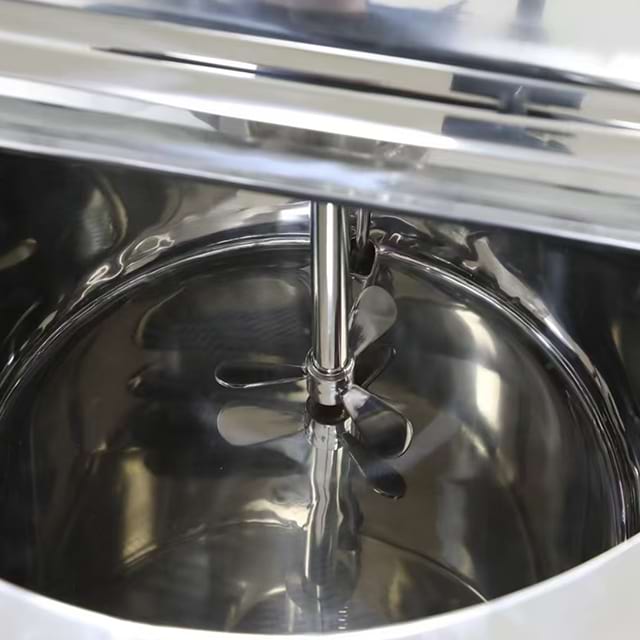
Scrapers physically contact the heated inner wall. They constantly remove the boundary layer of heated product. This continuous wiping action prevents product burn-on. It forces unheated center material outward to the jacket wall. This mechanical exchange ensures a perfectly homogeneous mix.
Some complex emulsions require intense processing. You need both precise heat and aggressive droplet disruption. In these cases, integrate bottom-entry high-shear homogenizers. The homogenizer stator pulls material in aggressively. It shears the droplets down to the micron level. This mechanical force ensures permanent emulsion stability under high heat.
Moving beyond manual thermostats is crucial for modern facilities. Manual dials lead to constant human error. Automated logic defines a highly capable precise temperature mixing tank. You must invest in smart control systems to ensure repeatability.
Sensor location determines your overall thermal accuracy. Single sensors create dangerous blind spots. You need multi-point PT100 temperature sensors instead. Install one sensor to monitor the jacket medium. Install another flush-mounted sensor for the core product. This dual approach prevents thermal lag completely.
Proportional-Integral-Derivative (PID) controllers are absolutely mandatory. Traditional thermostats just turn heaters on and off. PID controllers predict your system's thermal momentum accurately. The controller mathematically calculates the heat rise rate. It cuts power to the electric elements early. It stops the heating process before reaching the exact target temperature. This predictive logic prevents dangerous product overshooting.
Regulated industries require strict digital documentation. You need advanced PLC and HMI systems. Siemens or Allen-Bradley platforms work exceptionally well here. They ensure your facility meets 21 CFR Part 11 compliance. These systems offer fully traceable batch reporting. They also generate secure, unalterable digital audit trails. This level of data logging protects you during strict regulatory inspections.
Evaluate your energy consumption carefully. Large-scale electric heating mixing tanks operate differently than steam alternatives. Steam requires massive boiler infrastructure and extensive piping networks. Electricity provides direct, localized energy exactly where you need it. Electric systems convert nearly 100% of their energy into direct thermal output.
You must prevent ambient heat loss aggressively. Bare stainless steel wastes massive amounts of energy. High-density polyurethane cladding works well for moderate temperatures. Aluminum silicate serves high-heat oil applications perfectly. We call this insulation layer the outer jacket. This cladding protects your operators from severe contact burns. It also keeps your facility cooling bills highly manageable.
Implementation brings specific operational risks.
Follow this rigorous process to specify the exact equipment you need.
A: Heat-up time depends on several physical factors. It relies heavily on your total product volume. The specific heat capacity of your raw material matters greatly. The chosen jacket medium also alters the timeline. Most importantly, the total kW rating of the heaters dictates the speed. A standard 500-liter water-based batch might take 45 minutes using 24kW elements. Always calculate your exact Delta-T requirements.
A: Yes. Many advanced tanks handle both phases easily. Systems achieve this by using internal jacket cooling coils. Alternatively, they flush the hot jacket medium out completely. They then replace it with chilled water. Automated solenoid valves control this fluid exchange safely. This integrated approach saves valuable floor space. It eliminates the need to pump hot product to a separate cooling vessel.
A: This involves a direct facility trade-off. Electricity often carries a higher utility cost per BTU. Natural gas or steam might seem cheaper hourly. However, electric tanks require absolutely zero boiler infrastructure. You avoid expensive pipe fitting and boiler maintenance entirely. This makes electric systems highly cost-effective for mid-sized facilities. They are also ideal for isolated cleanroom environments.
A: Elements typically last between one and three years. This timeline depends on your daily usage intensity. The quality of your jacket fluid also dictates lifespan. Hard water causes rapid calcium scaling. Thermal oil can cause carbon fouling over time. Emphasize low-watt-density elements during the design phase. Spreading the electrical load over a larger surface area prolongs their operational lifespan significantly.