Please Choose Your Language


Views: 0 Author: Site Editor Publish Time: 2026-07-01 Origin: Site


Specifying equipment for commercial processing plants poses a distinct engineering challenge. You must simultaneously manage aggressive thermal transfer, complex fluid dynamics, and strict regulatory food-grade compliance. Finding the right balance demands careful attention. If you get this wrong, the financial and operational consequences cascade rapidly. An under-specced unit causes severe batch inconsistencies and ruins valuable product via localized burn-on. Conversely, over-specced machinery drains your capital reserves and damages overall operational efficiency. We have a clear objective for this article. We aim to provide plant engineers and procurement teams a pragmatic, engineering-focused framework. We will help you thoroughly evaluate a rotating heating mixing tank without relying on superficial sales claims. You will learn exactly how to align thermodynamic requirements with advanced mechanical capabilities to ensure flawless, repeatable production runs.
Every successful equipment purchase starts by analyzing the raw material. You cannot select mechanical hardware until you thoroughly understand fluid behavior. Food products react unpredictably under thermal stress. Process engineers must define the exact physical demands before contacting vendors.
Assess how your food product behaves under temperature changes. Some formulations become highly fluid upon heating. Conversely, complex starches often gelatinize. They thicken significantly as temperatures rise. This transformation shifts the mechanical load entirely. Think about heating a heavy caramel or processing a thick fruit puree. The product starts thick, thins out, then thickens again during the cooling phase. Your equipment must handle the absolute highest torque requirement along this curve. We recommend plotting a complete rheological profile. It helps you avoid stalling the motor mid-batch.
Calculate the required temperature rise. Establish your acceptable time-to-temperature window. Heating one thousand liters of tomato paste from ambient temperature to a rolling boil requires massive energy input. Faster heating forces you to use higher internal surface areas. Alternatively, you must apply a much hotter utility media. Both choices immediately increase product burn-on risks. A sudden influx of intense heat shocks delicate ingredients. You must calculate the precise thermal transfer coefficients. This ensures you deliver adequate energy without degrading the food quality.
Internal mechanics depend entirely on how your product tolerates physical stress. Detail whether the product requires gentle blending or intense high shear.
Defining these parameters dictates your impeller styles, motor sizing, and baffle placement.
Once you define the product characteristics, you must select an appropriate heat transfer mechanism. The outer thermal layer dictates process efficiency. Selecting the wrong utility media causes sluggish cycle times and uneven heating.
Different plants utilize different utility infrastructures. You must evaluate the three primary heating methods carefully.
| Media Type | Primary Advantage | Ideal Application | Key Limitation |
|---|---|---|---|
| Electric Heating | Lower upfront infrastructure requirements. Highly precise temperature control. | Smaller batches, skid-mounted systems, or facilities lacking boilers. | Struggles to deliver rapid heat-up for very large commercial volumes. |
| Steam Heating | Rapid latent heat transfer. Leverages existing plant utilities easily. | High-volume commercial cooking, rapid boiling, and sanitization. | Requires strict pressure regulation and certified pressure vessel ratings. |
| Thermal Oil | Achieves extreme temperatures (up to 300°C) without generating high system pressure. | Frying, rendering, and processing heavy syrups or hard candies. | Slower thermal response times during emergency cooling cycles. |
Electric systems utilize submerged elements heating a localized water or oil bath. They offer plug-and-play simplicity. Steam systems inject pressurized vapor into the cavity. Steam collapses upon contact, transferring massive latent energy instantly. Thermal oil systems circulate synthetic fluids. They excel in ultra-high-temperature scenarios where steam pressure would become structurally hazardous.
You must match the jacket design to your chosen heating media and pressure requirements.
Exposed hot metal endangers personnel. Specify minimum cladding thickness. Use high-density polyurethane (PU) foam or mineral rock wool. Proper insulation protects operators from severe burns. Furthermore, it prevents massive thermal loss into the surrounding room. An uninsulated vessel forces your HVAC system to work harder. It also forces your boiler to burn excessive fuel to maintain batch temperatures.
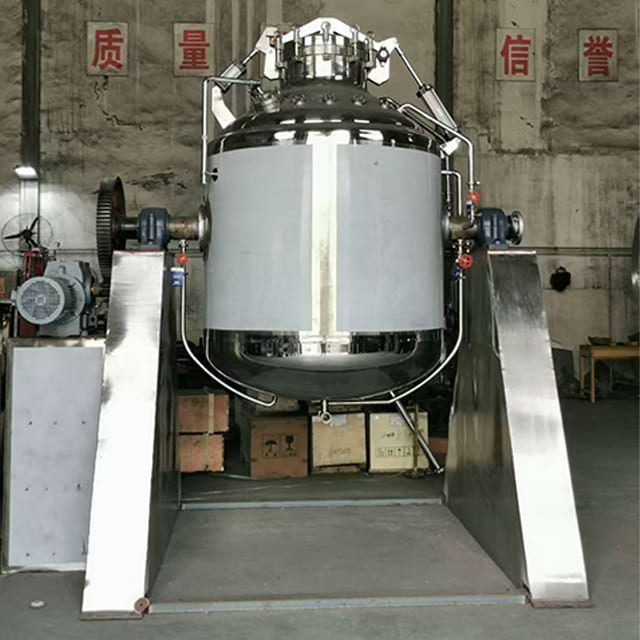
Thermodynamics represent only half the equation. You must move the product effectively to distribute thermal energy. Poor fluid motion causes hot spots. A well-designed agitator mixer eliminates thermal gradients entirely.
A heated vessel wall constantly creates a thermal boundary layer. When viscous material touches hot steel, it sticks. If it stays there, it scorches quickly. Burn-on acts as an unwanted insulator. It destroys heat transfer efficiency and ruins the batch flavor. Equipment handling heated foods must utilize spring-loaded or hinged Teflon (PTFE) wall scrapers. These scrapers drag along the interior surface constantly. They shave off the heated boundary layer. They fold the hot material back into the cooler center. This mechanical action ensures perfectly homogeneous heat distribution.
Evaluate your mixing motion based on absolute viscosity.
Single-motion anchors sweep the walls efficiently. They work well for broths, light sauces, and thin beverages. However, thick pastes defeat single-motion designs. The entire mass simply spins inside the cylinder without actually blending.
Contra-rotating designs solve this problem. The outer anchor frame sweeps clockwise, scraping the walls. Meanwhile, a central shaft featuring angled pitched blades spins counter-clockwise. This opposition creates massive internal shear. The inner blades push material outward. The outer anchor pushes it inward. This design forces highly viscous pastes to turn over continuously.
Always look for Variable Frequency Drive (VFD) compatibility. A VFD allows operators to adjust speeds dynamically. You can run fast during initial heating. You can slow down during delicate holding phases.
Consider the mounting location carefully. Top-mounted motors keep critical seals far above the liquid level. This placement drastically reduces contamination risks. Bottom-mounted motors save overhead space. They utilize magnetic drives or specialized mechanical seals. However, bottom-mounted units face constant hydrostatic pressure. They require rigorous, ongoing maintenance to prevent catastrophic floor leaks.
Marketers frequently use the term "food grade" loosely. Engineers must demand strict, verifiable sanitary construction. A true food processing mixing tank adheres to established global benchmarks. You cannot compromise on material chemistry or surface topography.
You must differentiate between standard alloys. Manufacturers often use 304 stainless steel for outer cladding and support legs. It provides excellent structural integrity. However, it fails under aggressive chemical conditions.
You must specify 316L stainless steel for all wetted internal parts. The "L" denotes low carbon content. More importantly, 316L contains molybdenum. This element specifically resists chloride corrosion. Acidic foods like tomato paste, citrus juices, or brines attack standard 304 steel. Over time, pitting occurs. Pitting harbors dangerous bacteria. Insist on 316L material certificates before signing any purchase order.
Microscopic scratches breed pathogens. You must specify minimum surface roughness requirements.
Inspect the fabrication techniques. Insist on continuously polished, seamless internal welds. Grinders must eliminate all weld discoloration. The interior must contain absolutely zero dead corners. A dead corner traps product fragments permanently.
Manual scrubbing wastes labor and introduces human error. Ensure the vessel supports Clean-in-Place (CIP) and Sterilize-in-Place (SIP) protocols.
Evaluate spray ball placement. Static spray balls or rotary jet heads must cover the entire upper dome. They must flush the agitator shaft completely. Check the bottom geometry. Flat bottoms fail sanitary tests. They leave standing puddles. Ensure the unit features a steeply conical or properly dished bottom. A self-draining geometry guarantees total fluid evacuation between distinct product batches.
Excellent equipment often fails during installation. Procurement teams frequently overlook facility constraints. You must calculate the total implementation load before finalizing any machinery shortlists. Ignoring these realities causes severe project delays.
Measure your physical environment precisely. Do not just measure the floor footprint. Factor in the vertical ceiling height. Mechanical seals eventually require replacement. Maintenance crews must hoist the heavy agitator shaft straight up and out of the vessel. If your ceiling sits too low, you cannot perform basic maintenance.
Additionally, leave adequate walking space around the perimeter. Technicians need room to inspect jacket valves, steam traps, and electronic sensors. Cramming a large unit into a tight corner guarantees future operational headaches.
Never assume your building can support new machinery blindly. Verify your facility’s exact infrastructure limits.
Map these utilities carefully. A beautiful piece of machinery becomes an expensive paperweight if you lack the infrastructure to power it.
Successful procurement relies heavily on marrying thermodynamic requirements with precise mechanical agitation. You cannot treat heating systems and blending mechanisms as isolated components. They must operate as a unified system to prevent product degradation.
We recommend standardizing your Request for Quote (RFQ) process. Build a comprehensive technical dossier. Always provide vendors with exact product viscosity metrics and specific gravity data. Clearly state your target temperature gradients and maximum allowable batch times. Ask vendors to submit their heat transfer calculations alongside their mechanical drawings.
Take charge of the selection process. Inspect material certificates strictly. Demand high-quality surface finishes. Measure your facility utilities beforehand. By following this engineering-focused framework, you will secure robust machinery. You will eliminate batch inconsistencies, protect your product quality, and ensure seamless commercial scaling.
A: A standard tank provides basic fluid blending at ambient temperatures. A heating tank integrates pressurized thermal jackets combined with specialized agitation. These systems often utilize heavy-duty wall scrapers specifically designed to manage intense temperature gradients, prevent localized product scorching, and maintain homogeneous thermal transfer.
A: Yes, if equipped with a dual-zone or multi-purpose utility jacket. Operators can circulate steam to heat the batch, then switch valves to circulate chilled water or glycol. However, cooling efficiency depends heavily on the incoming fluid temperature, flow rate, and the continuous effectiveness of the wall scrapers.
A: You must cite and request specific engineering documents. Ask for Mill Test Reports (MTRs) to verify genuine 316L stainless steel composition. Request FDA compliance certificates for all elastomers, gaskets, and Teflon scraper blades. Finally, demand surface roughness test reports proving the interior meets Ra 0.8µm standards.