Please Choose Your Language


Views: 0 Author: Site Editor Publish Time: 2026-07-02 Origin: Site


In industrial liquid processing, relying on ambient-temperature blending often leads to inconsistent batch quality. Static mixing frequently extends cycle times and causes localized product degradation. These outdated methods struggle to handle complex fluid dynamics efficiently. For high-viscosity fluids or temperature-sensitive emulsions, mechanical agitation alone remains insufficient. Reactive chemical blends also demand more than simple stirring. The physical properties of these fluids must undergo active management during the entire mixing cycle to ensure homogeneity. Integrating targeted thermal control fundamentally alters fluid rheology. Dynamic agitation directly impacts yield consistency and overall processing efficiency. This comprehensive guide outlines how you can evaluate and specify advanced thermal mixing equipment. We will explore practical steps to solve complex processing bottlenecks and elevate your facility's output.
Unheated tanks create severe thermal gradients during operation. These gradients manifest as persistent cold spots inside the vessel. Cold spots prevent solids from dissolving properly, leading directly to failed batches. Poorly heated systems struggle to maintain uniform temperatures across large volumes. As a result, product quality fluctuates wildly from one run to the next. Operators in cosmetics or chemical manufacturing often notice these inconsistencies during quality control checks.
We also face the viscosity trap. Operators often increase mechanical shear to compensate for thick, unyielding fluids. Pushing impellers harder consumes excessive electrical energy. It also risks inflicting shear damage on sensitive emulsions or delicate polymer chains. You cannot simply force a highly viscous product into submission using raw motor power alone. This brute-force approach damages equipment and ruins heat-sensitive ingredients.
Common Mistake: Upgrading the agitator motor to a higher horsepower without adding a thermal jacket. This increases energy consumption but fails to solve the underlying viscosity issue.
Processing bottlenecks severely cripple facility throughput. Extended batch cycle times mean fewer runs per shift. This reduction in volume limits your capacity to meet market demands. Furthermore, product scaling at the vessel walls generates substantial waste. This "burn-on" effect ruins valuable raw materials. Removing it requires intensive manual intervention or aggressive chemical treatments. Cleaning out burned product easily consumes hours of potential production time.
Regulated industries face even steeper consequences. Pharmaceutical and food sectors demand strict compliance. Inconsistent homogenization threatens these rigorous quality standards. Failing to achieve uniform blending risks severe regulatory penalties or catastrophic product recalls. Ensuring batch-to-batch repeatability is non-negotiable for GMP-certified facilities.
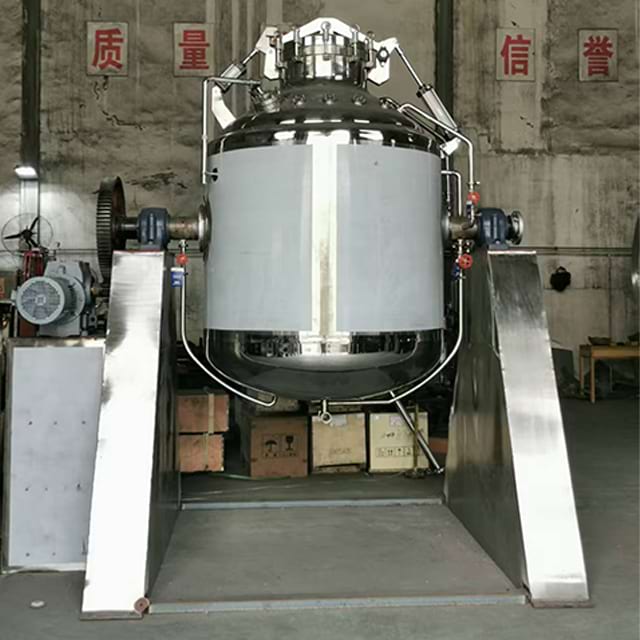
Raising the bulk temperature exponentially lowers fluid resistance. Heat provides thermal energy to the molecules, increasing their overall mobility. This physical change expands the effective mixing radius of the impeller. A rotating heating mixing tank leverages this principle perfectly. As viscosity drops, the agitator moves fluid more freely. You no longer need oversized motors to achieve total turnover. The synergy between heat and motion creates a highly efficient blending environment.
Consider the production of heavy syrups or cosmetic creams. At room temperature, these products resist flow stubbornly. Heating the vessel instantly transforms the fluid dynamics. The agitator blades slice through the material easily. This allows ingredients to intermingle at a molecular level much faster.
Static heating relies heavily on slow conduction. Continuous rotating agitation changes this dynamic entirely. The impeller constantly sweeps fluid across the heated tank surface. This sweeping action maximizes convective heat transfer throughout the batch. It rapidly disperses thermal energy and eliminates localized hot spots. The fluid closest to the jacket absorbs heat and immediately cycles back into the bulk volume.
This continuous replacement ensures uniform temperature distribution across the entire vessel. By relying on forced convection rather than passive conduction, processing times plummet. Heat penetrates the center of the tank rapidly. Engineers refer to this as improving the overall heat transfer coefficient.
Boundary layers present a major challenge in heated mixing. Viscous fluids tend to adhere to hot metal surfaces. This stagnant layer acts as an insulator, blocking heat transfer. Continuous scraping mechanisms disrupt these boundary layers effectively. Targeted flow patterns also prevent product from lingering too long near the heat source. By physically clearing the heated walls, the system maintains high thermal efficiency.
This active surface management prevents scale formation. It protects product integrity throughout the heating cycle. Scraped-surface agitators physically wipe the metal clean on every rotation. This prevents sugars from caramelizing and proteins from denaturing. Maintaining clean walls guarantees optimal thermal conductivity from start to finish.
Engineers must match the heating jacket to the application. You have three primary architectural choices when designing your vessel. Choosing incorrectly limits your processing capabilities.
Heating Architecture Comparison
| Jacket Type | Ideal Heating Media | Pressure Rating | Best Application |
|---|---|---|---|
| Dimple Jacket | Steam, Hot Water | Low to Medium | General processing, hygienic environments |
| Half-Pipe Coil | Thermal Oil, High-pressure Steam | High | High-temperature, heavy thermal stress |
| Conventional Double Wall | Warm Water, Chilled Water | Low | Basic heating, low-budget projects |
Different viscosities demand specific agitator geometries. Fluid rheology dictates the mechanical design of your internal components.
Best Practice: Always request a rheology test on your raw materials. A fluid might appear thin at rest but thicken drastically under shear stress (dilatant fluids).
Selecting the correct alloy ensures long-term durability. A standard stainless steel mixing tank typically uses 304 or 316L grades. Type 304 works well for basic chemical and food applications. However, 316L provides superior corrosion resistance under elevated temperatures. Chlorides and acidic compounds aggressively attack standard steel when heated.
Furthermore, hygienic applications demand specific surface finishes. Pharmaceutical and food-grade tanks require an internal finish of Ra < 0.8 µm. This smooth surface prevents bacterial growth and ensures easy cleaning. Weld seams must be polished flawlessly to meet FDA expectations. Pitting or rough welds will harbor microbes and ruin subsequent batches.
Before procuring new equipment, you must assess your facility. Does your plant possess adequate utility capacity? Heated tanks draw significant energy from existing boilers or chillers. Evaluate your current steam generation or hot water loops carefully. Thermal fluid systems require dedicated piping and specific safety controls. Installing a high-performance tank without sufficient utility backing leads to chronic underperformance. The heating jacket cannot compensate for an undersized facility boiler.
You must calculate the peak energy load. Bringing a full tank from ambient temperature to processing temperature requires immense energy. Once the target temperature is reached, maintaining it requires significantly less power. Ensure your infrastructure can handle the initial thermal spike.
Cleaning complex agitator geometries presents significant engineering challenges. Spray balls must reach behind baffle plates and under impeller blades. Blind spots trap residue and invite dangerous cross-contamination. Modern systems integrate seamlessly with Clean-In-Place (CIP) protocols. They utilize strategically placed nozzles to ensure total coverage.
Additionally, Sterilization-In-Place (SIP) introduces extreme thermal stress. The heating system and vessel must support high-temperature steam cycles. Mechanical seals must withstand this rapid expansion without degrading or leaking. You must specify SIP-compatible seals during the engineering phase to prevent catastrophic failures during sanitation cycles.
Routine inspections keep your equipment running smoothly and prevent unexpected breakdowns.
Standard designs suit many basic applications perfectly. They handle standard Newtonian fluids like simple syrups or basic chemical dilutions. Off-the-shelf units handle straightforward water-based heating efficiently. If your blending operation is non-critical, standard models save time and capital. They arrive faster and require minimal engineering oversight. You simply connect the utilities and begin processing.
Small-scale breweries or basic liquid soap manufacturers often thrive using standard vessels. The fluid dynamics remain predictable, and extreme thermal tolerances are unnecessary.
Complex processes demand bespoke engineering. Highly non-Newtonian fluids change viscosity unpredictably under shear. Strict multi-zone temperature profiling requires custom jacket configurations. Integrating a tank into an automated, continuous-process line demands tailored sensors and PLC interfaces. Standard tanks fail under these demanding conditions.
Next-Step Action: If you face these challenges, take action immediately. Prepare a detailed process specification sheet. Include the total volume, maximum and minimum viscosity, and specific heat capacity of your product. Define your target batch time clearly. Present this comprehensive data to equipment manufacturers. This information enables them to engineer a precise, purpose-built solution.
Upgrading to a seamlessly integrated heating and agitation system represents a strategic shift. It is not merely a routine equipment purchase. This integration drives predictable batch yields and significantly reduces process times. You gain complete control over your fluid rheology.
The initial capital expenditure for a tightly specified system is quickly offset. You achieve this through a dramatic reduction in wasted batches and lower energy consumption. Faster throughput further accelerates your financial returns. Modern manufacturing requires this level of efficiency.
Before committing to fabrication, validate your design thoroughly. Ask your manufacturer for a computational fluid dynamics (CFD) simulation. Request a pilot-scale test using your actual product. These critical steps verify the agitator and jacket design. They ensure optimal performance from day one.
A: A standard double-wall jacket creates a wide, open space for heating media. This often leads to lower pressure ratings and slower fluid velocity. A dimple jacket uses plug welds to create a dimpled surface. This specific design dramatically increases the vessel's overall pressure rating. It also allows manufacturers to use thinner metal. Furthermore, the dimples induce turbulent flow in the heating media, significantly enhancing heat transfer efficiency.
A: Fluid viscosity determines how easily the product circulates. Low-viscosity fluids move easily. Flow-driven impellers like propellers distribute heat perfectly. As viscosity increases, these impellers struggle; they only carve holes in the thick fluid. High-viscosity materials demand wall-scraping anchor agitators. These scrape the heated boundary layer continuously. They force thick material toward the center, ensuring uniform heat distribution.
A: Technically yes, but practically it poses severe technical risks. Welding a jacket onto an existing vessel post-fabrication warps the metal. This distortion compromises the tank's original pressure rating. It also destroys the internal sanitary finish completely. You must re-polish the interior and re-certify the pressure vessel. Replacing the unit is often safer, faster, and more cost-effective than attempting a retrofit.
A: Thermal tolerance depends entirely on the system's control components. Proper sensor placement using precise PT100 thermocouples is critical. When paired with an advanced PID controller and highly efficient agitation, the system responds instantly to thermal fluctuations. In fully optimized systems, typical thermal tolerances can be held consistently within ±1°C to ±0.1°C. This ensures safe processing for sensitive emulsions.