Please Choose Your Language


Views: 0 Author: Site Editor Publish Time: 2026-09-07 Origin: Site


Selecting the right metallurgy for your Electric Heating Mixing Tank requires balancing upfront specifications against long-term risk management. Material decisions directly impact equipment lifespan and product safety. While 304 stainless steel serves as the industry default, introducing electric heating jackets fundamentally changes how the metal reacts to chemicals, salts, and cleaning agents. Thermal stress accelerates chemical reactions. This dynamic pushes standard materials beyond their normal limits. Under-specifying leads to localized pitting, batch contamination, and premature equipment failure. Conversely, over-specifying wastes valuable manufacturing resources unnecessarily. In this guide, you will learn how thermal dynamics alter material performance and why specific alloys matter. We will explore the chemical differences between 304 and 316L under heat. Finally, you will discover a practical framework to evaluate which stainless steel best fits your specific formulation needs.
Heat accelerates corrosion: For every 10°C rise in temperature, chemical reaction rates (and corrosion risks) roughly double, making material choice critical in heated applications.
The "L" matters for heated jackets: 316L (Low Carbon) prevents carbide precipitation during the welding of heating jackets, ensuring structural integrity at the seams.
Molybdenum is the differentiator: 316L contains 2-3% Molybdenum, providing essential resistance to chlorides (salts) and acidic formulations that 304 cannot handle at elevated temperatures.
ROI depends on the application: 304 is cost-effective for neutral, low-chloride batching; 316L is mandatory for high-salinity foods, cosmetics, pharmaceuticals, and harsh CIP (Clean-in-Place) chemical regimes.
Understanding the elemental composition of stainless steel reveals why these two grades perform differently. Both alloys rely on a microscopic chromium oxide layer to prevent rust. However, their secondary elements dictate how well they survive aggressive environments.
Material Grade | Chromium (%) | Nickel (%) | Molybdenum (%) | Carbon (Max %) |
|---|---|---|---|---|
304 Stainless Steel | 18.0 | 8.0 | 0.0 | 0.08 |
316L Stainless Steel | 16.0 | 10.0 | 2.0 - 3.0 | 0.03 |
Standard 304 stainless steel contains roughly 18% chromium and 8% nickel. It offers excellent structural durability and oxidation resistance in ambient conditions. You can confidently deploy it for standard, non-corrosive batching processes. Common safe applications include purifying water, blending neutral oils, and basic dairy processing.
Despite its versatility, 304 possesses a critical vulnerability. It lacks molybdenum. This absence makes the alloy highly susceptible to chloride-induced pitting. When exposed to salts or mild acids, the protective chromium layer breaks down. Adding heat to this environment rapidly exacerbates the degradation.
Upgrading to 316L introduces two crucial metallurgical defenses. First, the addition of 2% to 3% molybdenum transforms the material's chemical resilience. Molybdenum acts as a microscopic barrier against chloride attack. It stabilizes the passive oxide layer, preventing salt ions from piercing the metal surface.
Second, the "L" designates a low-carbon composition. Standard stainless grades contain up to 0.08% carbon. Grade 316L restricts carbon to a maximum of 0.03%. This minute adjustment prevents a phenomenon called sensitization. When manufacturers weld electric heating jackets or internal agitator baffles, the metal reaches extreme temperatures. High heat normally causes carbon to bind with chromium, creating chromium carbides. This process depletes the surrounding boundary layer of its protective chromium. By drastically reducing the carbon content, 316L ensures the weld seams remain highly corrosion-resistant.
Always request detailed material specifications before procurement. Ensure your engineering team verifies the exact chemical concentration of your raw ingredients. Even trace amounts of chlorides require molybdenum-fortified steel.
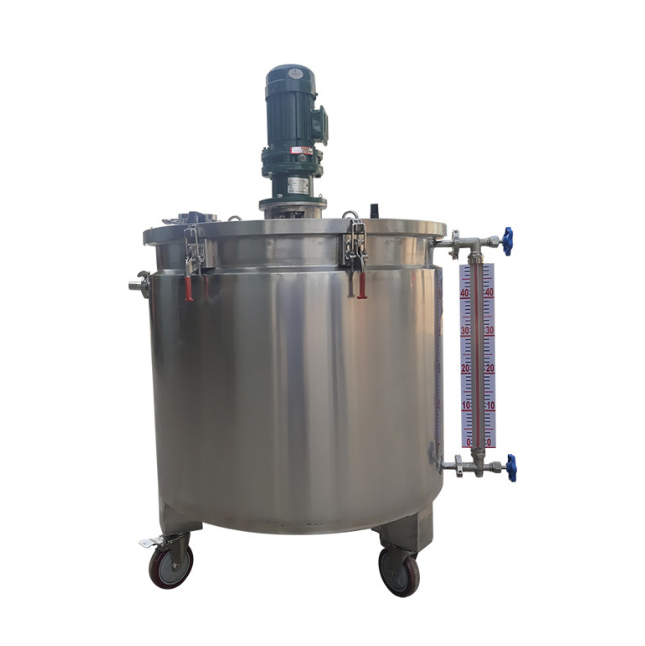
Applying thermal energy to a liquid fundamentally shifts the chemical physics inside the vessel. A formulation behaving passively at room temperature often turns highly aggressive once heated.
Chemical reaction rates scale dramatically alongside temperature. According to standard thermodynamic principles, reaction speeds roughly double for every 10°C increase. A saline solution sitting safely in a cold 304 vessel may violently attack the exact same metallurgy when heated to 80°C or 100°C. Heat energizes chloride ions, allowing them to penetrate the passive film faster than the metal can repair itself.
Electric heating systems rely on direct elements or jacketed heat transfer mechanisms. The physical boundary layer touching the heated wall experiences significantly higher temperatures than the bulk fluid circulating in the center. These localized hot spots create intense thermal gradients. High surface temperatures paired with mechanical agitation increase the risk of Stress Corrosion Cracking (SCC) in standard 304 steel. The heated wall effectively becomes a micro-environment where corrosion occurs exponentially faster.
As mixtures heat up, liquid naturally evaporates. This evaporation creates a dynamic phenomenon at the liquid line. When water turns to vapor, it leaves dissolved solids behind. Consequently, the concentration of chlorides and salts spikes right at the meniscus line. This highly concentrated ring creates a severe risk zone for pitting. If the tank lacks molybdenum, this horizontal band will quickly show signs of deep surface oxidation.
Operators frequently test ingredient compatibility at room temperature. They assume the results apply to heated phases. Always test material compatibility at your peak operating temperature to avoid unexpected equipment failure.
Matching the right alloy to your specific product formulation requires a systematic approach. Evaluate your raw ingredients, peak temperatures, and industry compliance mandates before finalizing a decision.
You can safely deploy standard 304 stainless steel in strictly controlled, low-risk environments. It remains highly efficient for non-aggressive batching where chemical degradation risks are verifiably low.
Brewing Operations: Hot liquor tanks and non-acidic mashing stages function perfectly well using 304 steel.
Basic Dairy Processing: Pasteurizing milk or blending neutral dairy bases rarely involves high chloride concentrations.
Neutral Cosmetics: Melting natural waxes, blending basic lotions, and mixing non-reactive skincare bases.
Low-Chloride Foods: Syrups, neutral beverages, and simple carbohydrate blends.
For these applications, 304 optimizes your equipment specifications without over-engineering the solution. It provides robust structural integrity and excellent sanitation capabilities.
Aggressive formulations absolutely require the enhanced protection of 316L. Specifying a high-performance Mixing Tank engineered from 316L guarantees sanitary compliance and prevents rapid material breakdown.
High-Chloride Foods: Manufacturing sauces, ketchups, meat brines, and savory soups involves combining salt with high heat. This environment mandates molybdenum protection.
Pharmaceutical & Biotech (cGMP Compliance): Regulatory bodies require ultra-pure environments. Any micro-pitting could harbor bacteria or cross-contaminate active ingredients. Grade 316L accepts a superior mechanical and electropolish finish, ensuring sterile conditions.
Advanced Cosmetics & Chemicals: High-acidity formulations, shampoos utilizing high-salt surfactants, and aggressive industrial chemicals easily strip the passive layer from standard steel.
The daily operational realities of heated vessels extend beyond just blending ingredients. You must heavily weigh how the equipment responds to rigorous cleaning protocols over thousands of cycles.
Sanitizing heated tanks frequently requires aggressive CIP (Clean-in-Place) and SIP (Sterilize-in-Place) protocols. Facilities regularly flush vessels using hot caustic soda, nitric acid, or phosphoric acid to remove stubborn, baked-on residues. Grade 316L easily withstands high concentrations of these hot chemicals over decades of daily cycles. It maintains its structural and surface integrity without degradation. Conversely, standard 304 may gradually lose its passive layer under identical chemical abuse. Over time, repeated acid washes can leave standard steel vulnerable to flash rusting.
A compromised internal surface finish drastically increases cleaning times and operational downtime. Pharmaceutical and food-grade applications demand a smooth sanitary finish, typically measured at Ra < 0.8 µm. When pitting occurs, microscopic crevices form. These crevices trap organic material and shield bacteria from CIP chemicals. Because 316L resists chemical etching and pitting, it maintains this smooth sanitary finish significantly longer in corrosive, heated environments.
Translating metallurgical theory into a concrete purchasing decision requires strategic evaluation. Focus heavily on lifecycle reliability, verifiable manufacturing standards, and smart design choices.
Selecting materials strictly based on baseline availability often leads to unintended consequences. You must factor in the operational realities of deploying standard 304 in an improper application. Unscheduled downtime, entire batch contamination, and failed sanitary audits create severe operational disruptions. More importantly, chemical pitting can force premature tank replacement. A mismatched vessel might fail within 3 to 5 years. A properly specified 316L vessel handling the same aggressive formulation can easily operate for 15 to 20 years or more.
You must rigorously verify the materials used by your equipment provider. Do not accept verbal assurances regarding steel grades.
Request Mill Test Reports (MTRs): These documents trace the precise chemical composition of the steel sheets used to build your vessel. They confirm the exact percentage of molybdenum and carbon.
Check Weld Quality: The integrity of a heated jacket relies entirely on the welds. Ensure the manufacturer uses proper shielding gas during fabrication. They must also perform thorough pickling and passivation processes to restore the steel's protective oxide layer around the heating elements.
You do not always need to manufacture the entire unit from a single premium alloy. An excellent efficiency tip involves utilizing a hybrid material design. You can specify 316L for the inner tank shell, product contact zones, and heated surfaces. Simultaneously, you can specify 304 for the outer insulating jacket, external cladding, and non-contact structural supports (like legs and motor mounts). This strategy maximizes chemical resistance exactly where you need it while optimizing the overall equipment build.
Navigating the choice between 304 and 316L stainless steel requires a clear understanding of your specific process environment. Let the formulation's acidity, chloride content, and peak operating temperature dictate your metallurgy. Introducing thermal energy significantly amplifies the corrosive potential of everyday ingredients. Do not compromise on 316L if your process involves salt, high heat, or strict FDA and pharmaceutical compliance mandates. For neutral, low-temperature, and non-corrosive applications, you can safely leverage 304 to optimize your equipment specifications. Always consult directly with experienced equipment engineers. Provide them with your exact chemical formulations and temperature targets to ensure they design a customized, highly reliable vessel tailored to your facility.
A: No. Heat rapidly accelerates chloride pitting. Because 304 lacks molybdenum, it cannot withstand the corrosive attack of heated salts. Grade 316L is strictly required for any heated brine or saltwater applications.
A: It slightly lowers the overall tensile strength compared to standard 316. However, this difference is negligible for standard atmospheric or low-pressure mixing tanks. The low carbon content remains absolutely crucial for preventing weld decay in heated jackets.
A: No stainless steel is 100% rust-proof. Grade 316L is highly resistant, but extreme chloride exposure, lack of oxygen, or improper CIP cleaning can still cause surface oxidation. Regular passivation maintains its defensive layer.
A: While electropolishing or chemical passivating helps temporarily, you cannot change the underlying metallurgical lack of molybdenum. If your chemical application demands 316L, applying surface treatments on a 304 vessel will only provide a temporary fix.