Please Choose Your Language


Views: 0 Author: Site Editor Publish Time: 2026-07-17 Origin: Site


Extraction efficiency goes far beyond basic chemistry. It acts as the primary engine driving profitability, throughput, and product consistency across commercial manufacturing facilities. When plant managers look to optimize yields, they often start by tweaking chemical inputs. Selecting the right solvent and prepping raw materials effectively provides a necessary baseline. However, the physical and thermodynamic limits of your processing equipment ultimately dictate your true production ceiling.
An inefficient vessel wastes valuable compounds and drains operational resources. In this guide, we will explore the critical operational parameters shaping your yields. You will discover how specific structural designs influence thermodynamic control and fluid dynamics. Finally, you will learn exactly which equipment specifications to prioritize when optimizing or upgrading your processing line.
Subpar extraction processes introduce severe hidden costs into daily operations. Many facilities fail to realize how much capital they lose through high solvent retention in spent biomass. When solvents remain trapped in the raw material, chemical replacement costs skyrocket. Additionally, poor temperature control often leads to the thermal degradation of active compounds. This degrades final product quality and diminishes market value. Extended batch times represent another massive drain. Every extra hour spent soaking materials reduces overall facility throughput.
A significant gap often exists between theoretical academic results and commercial production realities. In a laboratory setting, chemists work in small beakers. They achieve near-perfect mass transfer and optimal fluid dynamics. Scaling this process to a massive commercial batch introduces complex variables. Bulk biomass compacts tightly. Heat distributes unevenly. Solvents struggle to penetrate the center of large material beds.
| Parameter | Theoretical (Lab Scale) | Practical (Commercial Scale) |
|---|---|---|
| Mass Transfer | Near 100% immediate saturation | Inhibited by boundary layers and channeling |
| Temperature | Instantaneous, uniform control | Risk of hot spots or delayed core heating |
| Yield Expectation | Maximum theoretical recovery | Balanced against time and energy limits |
Relying purely on foundational chemistry simply isn't enough to bridge this gap. Commercial success demands robust hardware. You need an industrial extractor capable of maintaining precise, repeatable setpoints under a heavy load. Mechanical power and thermodynamic precision must work together. Without the right vessel, you will consistently fall short of your theoretical yield targets.
Understanding the physics behind extraction helps operators maximize their daily output. Four main operational parameters control the speed and completeness of the chemical separation process.
Elevated temperatures dramatically increase the carrying capacity of your solvent. Heat causes the solvent molecules to move faster. This rapid movement decreases fluid viscosity. A less viscous solvent penetrates the cellular matrix of the biomass much more easily. As a result, active compounds dissolve faster.
However, operators must manage the severe risk of thermal degradation. Many target compounds are highly heat-sensitive. Pushing temperatures too high destroys the exact molecules you want to harvest. Finding the optimal thermal setpoint requires balancing rapid dissolution against chemical preservation.
Pressurized environments actively force solvents deep into cellular matrices. This relies on capillary action to accelerate extraction rates. When you apply positive pressure inside the vessel, you compress any trapped air pockets inside the biomass. The solvent quickly replaces these air voids. This mechanical push ensures maximum contact between the liquid and the targeted solids. Precise pressure manipulation significantly reduces required batch times.
Mass transfer dictates how much solute a specific volume of solvent can hold. Operators must find the exact point of saturation equilibrium. Using too little solvent leaves valuable compounds behind in the biomass. Using too much solvent creates a different problem.
Excessive solvent usage leads to severe diminishing returns. While it might guarantee complete extraction, it drastically increases downstream processing costs. You must eventually boil off every extra gallon of solvent you use. Optimizing this ratio minimizes energy consumption later in the process.
Many operators mistakenly believe longer soaking times always yield better results. This is physically incorrect. Extraction follows a logarithmic curve. Most compounds dissolve rapidly in the first hour. Eventually, the concentration of the solute in the liquid equals the concentration remaining in the solid.
At this point of equilibrium, further soaking yields zero net gain. Extending batch duration past this limit wastes time and reduces facility throughput. Understanding your specific equilibrium point allows you to shorten batch schedules safely.
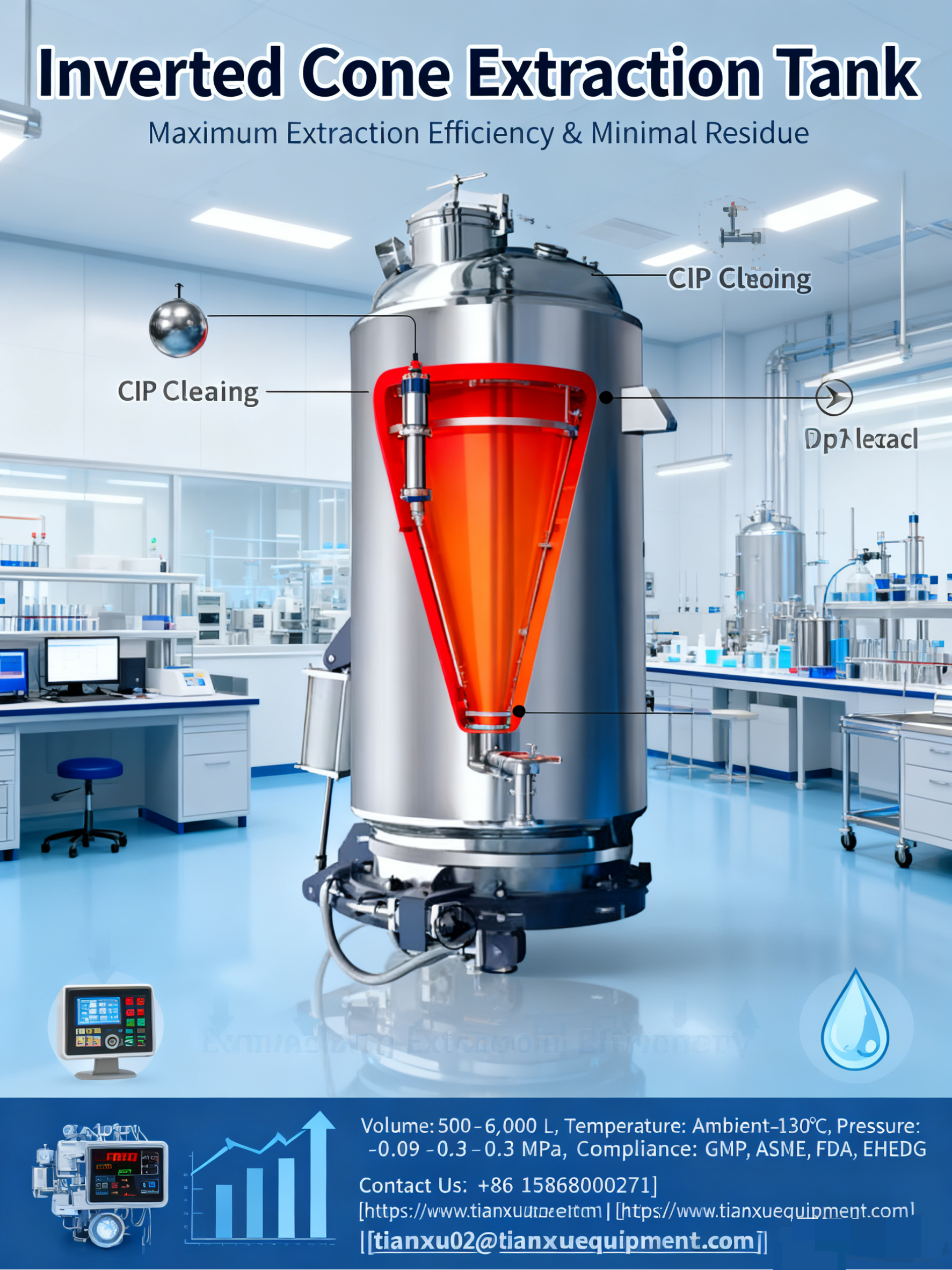
The physical construction of your vessel determines how well you can manipulate the parameters mentioned above. Process efficiency relies entirely on the structural intelligence engineered into the unit.
Rapid, uniform heating requires sophisticated vessel jacketing. A premium stainless steel extractor utilizes double or triple-jacketed walls. Thermal fluids circulate through these enclosed spaces. This design allows operators to heat or chill the internal mixture rapidly.
Single-wall vessels often create dangerous hot and cold spots. Hot spots scorch sensitive compounds near the vessel walls. Cold spots prevent optimal mass transfer near the center of the tank. Multi-zone jacketing eliminates these temperature gradients completely. This uniformity guarantees high batch-to-batch consistency.
Static soaking rarely produces commercial-grade yields. As solvent sits against a solid particle, a concentrated boundary layer forms. This layer acts as a physical shield. It prevents fresh solvent from reaching the remaining target compounds. You must break this boundary layer constantly.
Strategic agitation solves this problem. Different impeller designs serve different material types. Anchor impellers scrape the vessel walls to prevent buildup. Turbine impellers create high shear forces to tear apart clumped biomass. Proprietary paddle shapes generate complex axial and radial flow patterns. This continuous fluid motion constantly refreshes the contact area between the solvent and the biomass.
Metallurgy plays a critical role in equipment longevity and regulatory compliance. Most commercial facilities choose between two primary grades of steel.
For operations utilizing corrosive solvents or demanding strict GMP compliance, 316L stainless steel remains non-negotiable. It prevents microscopic pitting where bacteria can hide. Furthermore, the internal surface finish directly impacts turnaround times. A highly polished surface (low Ra value) prevents cross-contamination between batches. Smooth walls allow clean-in-place (CIP) spray balls to sanitize the vessel rapidly. Faster cleaning translates to more batches per week.
Optimizing the initial extraction phase represents only half the battle. A highly efficient processing setup quickly becomes bottlenecked if solvent recovery systems operate too slowly. This introduces the concept of total efficiency.
If your main vessel can process a batch in two hours, but recovery takes six hours, your true facility throughput remains restricted by the slower process. You cannot start a new batch until you recover the solvent from the previous one. To achieve total efficiency, facilities must integrate rapid downstream separation technologies.
Introducing a vacuum film evaporizer accelerates the separation of solvent from the crude extract. These advanced systems spread the liquid mixture into a microscopically thin film along a heated interior wall. A mechanical wiping system constantly renews this film.
This massive surface area allows the solvent to vaporize almost instantly. The system operates continuously under a deep vacuum environment. Applying a vacuum drastically lowers the boiling point of the solvent. Instead of boiling a solvent at 100°C, you might boil it at 40°C.
This low-temperature evaporation protects delicate botanical compounds from severe heat damage. The final crude extract maintains its natural profile, color, and efficacy. Meanwhile, the vaporized solvent condenses back into a liquid, ready for immediate reuse in the next batch.
Maximum profitability requires perfect system synergy. Facility managers must calculate the exact ROI of matching extractor throughput with appropriate downstream evaporative capacity. If you upgrade to a 2000L main vessel, you must scale your evaporation rate proportionally. Balancing these two phases ensures continuous, uninterrupted manufacturing loops.
Procuring commercial equipment requires rigorous technical evaluation. Plant managers should follow a structured decision framework to ensure the selected hardware meets long-term business goals.
Maximizing overall extraction efficiency requires a highly holistic approach. Plant managers must actively match thermodynamic principles with robust, precision-engineered hardware. Perfecting your solvent ratios and pressure dynamics means nothing if your vessel lacks the structural integrity to hold precise setpoints. True optimization links the initial separation phase directly to rapid downstream solvent recovery.
We encourage operational teams to audit their current processing metrics. Review your average batch times, daily yield data, and measurable solvent loss rates. If you identify severe bottlenecks or excessive hidden costs, an equipment upgrade becomes financially justified.
To stop leaving valuable compounds behind in your biomass, take action today. Request a comprehensive technical consultation from our engineering team. You can download detailed spec sheets directly from our product pages or review our complete line of advanced separation equipment online.
A: No. While moderate pressure improves solvent penetration through capillary action, exceeding the optimal limit yields diminishing returns. Excessively high pressure demands significantly thicker, more expensive vessel construction without proportional yield gains. It can also cause severe biomass compaction, which ultimately restricts solvent flow and damages final output quality.
A: 316L contains a specific percentage of molybdenum. This element offers superior resistance to pitting and structural corrosion caused by harsh solvents and acidic compounds. This high resistance is critical for ensuring long-term vessel durability, preventing microscopic cross-contamination, and meeting stringent GMP compliance standards in pharmaceutical applications.
A: It rapidly separates the liquid solvent from the crude extract under a deep vacuum. This environment drastically lowers the required boiling point. Lower heat speeds up solvent recovery for the next batch while completely preventing the thermal degradation of delicate target compounds in the final product.