Please Choose Your Language


Views: 0 Author: Site Editor Publish Time: 2026-07-15 Origin: Site


Scaling up botanical processing presents a profound operational challenge for modern facilities. You must achieve consistent active yields. Simultaneously, you must maintain strict regulatory compliance under GMP and FDA guidelines. It is rarely a simple process. Many processors struggle daily. They experience severe batch-to-batch variations. They often face degraded active compounds. These issues usually stem from poor thermal regulation. They also arise from contamination caused by substandard materials. Failing to address these mechanical flaws severely impacts product efficacy. It damages consumer safety profiles. This article breaks down the precise mechanical workflow of commercial extraction systems. We provide a clear technical framework for evaluating equipment upgrades logically. We exclude marketing hyperbole completely. We focus purely on the applied science. You will explore critical thermal dynamics. We cover solvent compatibility requirements in depth. You will also understand the metallurgical realities determining equipment lifespan and final output purity.
Operators begin by loading raw plant biomass into the primary vessel. Industrial solvents then flood the enclosed chamber. The physics of solvent penetration rely heavily on concentration gradients. The solvent dissolves active botanical compounds located on the plant surface initially. It then permeates the tough cellular walls. Osmotic pressure forces the intracellular solutes out. They transition into the surrounding liquid phase. Mechanical agitation mechanisms often assist this step. Impellers ensure uniform solvent saturation across the entire batch. They eliminate dry pockets inside the biomass bed. This uniform wetting is critical for high yields.
Heat accelerates the breakdown of plant cell walls. It dramatically increases solvent holding capacity. Jacketed heating systems surround the main tank exterior. They inject controlled steam or hot water into the insulated jacket space. This mechanism maintains optimal extraction temperatures. However, volatile thermolabile compounds degrade under excessive heat. You must control internal pressure tightly. Operators adjust vessel pressure to lower the solvent boiling point. This action preserves delicate terpenes and flavonoids. Precision pneumatic valves regulate these internal parameters constantly. They prevent sudden temperature spikes.
Modern systems do not let solvent sit idle. They utilize continuous fluid circulation. A heavy-duty pump pulls the saturated liquid from the bottom port. It routes the liquid back over the top of the biomass bed. Evaporated solvents rise naturally into a vertical condenser. The condenser cools them back into a liquid state. This liquid drips back into the herbal medicine extractor directly. This mechanical reflux action ensures maximum solute concentration. It minimizes expensive solvent waste drastically. It keeps the concentration gradient highly active.
The primary extraction cycle eventually concludes. The system must separate the saturated liquid from the spent biomass. The liquid transitions from the primary vessel into dedicated filtration pipelines. Multistage mesh filters trap rogue plant particulates. Specialized sanitary pumps prevent clogging during this critical transfer. A clean transfer ensures downstream purity for concentration stages. The spent biomass then discharges through a large bottom pneumatic valve. Automated discharge systems save considerable manual labor. They prevent operator exposure to hazardous residual fumes.
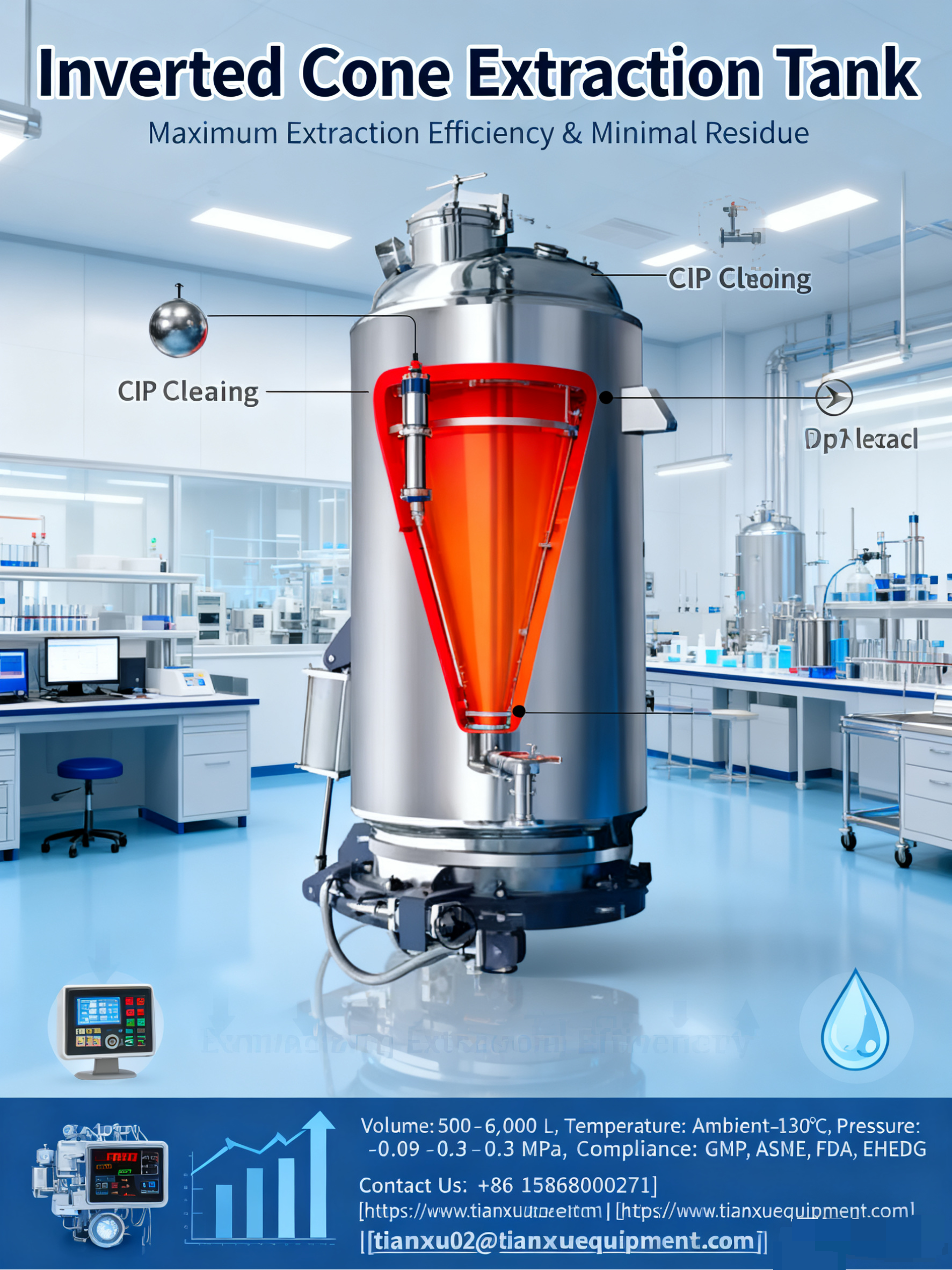
Material selection dictates final output quality entirely. Industrial stainless steel prevents batch contamination. Inferior materials like basic carbon steel rust quickly. Reactive alloys degrade rapidly when exposed to harsh industrial solvents. They risk heavy metal leaching into the final botanical product. Cross-contamination ruins entire production runs. It causes failed third-party lab tests. It triggers expensive product recalls. High-grade steel remains chemically inert. It does not react chemically. It protects the integrity of your active ingredients perfectly.
You must choose the right alloy for your specific process. The decision impacts long-term compliance heavily. We compare the two primary metallurgical options below.
| Alloy Type | Primary Applications | Corrosion Resistance | Compliance Level |
|---|---|---|---|
| 304 Grade | Aqueous or mild ethanol extractions | Standard resistance | General dietary supplements |
| 316L Grade | Acidic solvents, high salinity | Superior resistance (Molybdenum added) | Strict pharmaceutical GMP |
Standard 304 alloy works well for basic operations. It handles water or mild ethanol mixtures effectively. It provides a reliable baseline for general nutritional supplements. The 316L alloy contains added molybdenum. This elemental addition dramatically increases resistance against chloride pitting. It is mandatory for acidic environments. Strict pharmaceutical-grade GMP compliance demands 316L contact surfaces.
Raw metal harbors microscopic crevices. These tiny imperfections trap bacteria easily. They also hold stubborn organic residue. You need electropolished interior surfaces to prevent this. The pharmaceutical industry standard requires a roughness average (Ra) of ≤ 0.4 µm. This mirror-like finish prevents biofilm buildup entirely. It allows for verifiable batch-to-batch sanitation. A premium stainless steel extractor relies heavily on these finishes. Swab tests will fail consistently without them. Proper polishing minimizes cross-contamination risks between product changeovers.
Some botanical processors still use traditional methods. Maceration involves soaking biomass for extended periods. Percolation trickles solvent slowly through the dense material bed. These static setups suit low-budget operations well. They work for long-duration batch processing. They are ideal when compound thermal sensitivity is extremely high. They do not require complex heating jackets. However, they consume massive amounts of production time. Daily throughput remains very low.
Commercial facilities need faster turnaround times. Heat reflux systems serve as the modern industry standard. They maximize yield in much shorter processing cycles. They utilize continuous mechanical agitation alongside controlled heating. The constant physical movement prevents localized overheating. It ensures fresh solvent continually contacts unbroken plant cellular structures. This dynamic approach scales beautifully for medium to large production floors. It drastically reduces batch cycle times.
Modern facilities often consolidate their equipment footprints. They deploy advanced systems to save valuable floor space. These units combine dynamic extraction, vacuum concentration, and solvent recovery. Everything happens within a single closed-loop unit. A well-designed multifunctional extraction machine streamlines the entire workflow. It limits external fluid transfers. It reduces airborne contamination risks significantly. Solvents vaporize, condense, and recycle internally. Operators never face direct exposure to hazardous chemical fumes.
You must match your mechanical approach to your specific botanical compound. Follow this logical framework to align your equipment choices.
Do not confuse total tank volume with working capacity. An 800-liter vessel rarely holds 800 liters of active solvent and biomass. You must evaluate the true operational capacity accurately. The working volume usually sits around 70% to 80% of total interior space. This specific ratio dictates your maximum daily throughput. Overfilling the tank causes dangerous internal pressure spikes. It also causes liquid carryover into delicate vapor lines.
Solvents represent a massive ongoing chemical overhead. You must assess the system's condensation area accurately. Check the integrated vacuum capabilities closely. High recovery rates reduce chemical waste drastically. A strong vacuum lowers the solvent evaporation temperature. Large tube-and-shell heat exchangers turn vapor back into liquid rapidly. Efficient commercial systems recover over 90% of used solvents per operational cycle.
Manual operation invites costly human error. Modern systems rely on Programmable Logic Controllers (PLCs). Industrial PLC touchscreens allow for precise recipe management. Operators load pre-set processing parameters instantly. The system handles all temperature logging automatically. This data logging is critical for repeatable compliance audits. Regulatory inspectors demand verifiable historical batch data. Automated pneumatic valves and sensors ensure consistent process execution every time.
Physical facility constraints often dictate your final equipment choices. You must measure clear ceiling height carefully. Top-loading units require significant vertical clearance. Consider the overhead hoist space requirements for loading heavy biomass baskets. You also need to audit your facility utility demands. Ensure your boiler supplies enough clean steam. Check your cooling water chiller capacity. Verify your compressed air lines deliver sufficient pressure for pneumatic valves.
Sanitation protocols define ultimate product safety. You must evaluate the Clean-In-Place (CIP) design thoroughly. Look closely at the exact placement of rotary spray balls. Poor tank geometry creates hidden blind spots. Solvents and plant matter accumulate in these dead zones. They invite dangerous microbial growth. A poor CIP design leads directly to failed swab tests. Integrate Sterilize-In-Place (SIP) capabilities for true sterile pharmaceutical production.
Mechanical wear happens constantly in processing environments. You must address the reality of degrading consumable parts. Harsh chemicals destroy basic materials quickly. Solvents like hexane or high-proof ethanol degrade standard rubber rapidly. Leaking seals halt production immediately. We must highlight the necessity of premium materials. PTFE (Teflon) or Kalrez seals resist severe chemical attack. Replace them routinely to prevent catastrophic blowouts during pressurized runs.
Processing highly flammable solvents introduces extreme physical danger. Proper operator training minimizes these inherent risks. Staff must understand pressurized vessel dynamics thoroughly. Discuss the facility layout strictly with engineers. You must isolate flammable zones structurally. Install Class 1 explosion-proof (Ex-proof) motors exclusively. Control panels must meet strict hazardous location safety ratings. Proper ventilation systems must extract fugitive vapor emissions continuously. Safety always precedes yield optimization.
A commercial extraction system represents a foundational capital asset. It determines the absolute ceiling of your facility's production quality. You cannot out-process poorly manufactured equipment. We advise prioritizing vendors who provide transparent Factory Acceptance Testing (FAT). Demand verifiable material certificates for all stainless steel components. Reliable post-installation support matters significantly more than baseline pricing. Cheap equipment always costs more in maintenance downtime. We encourage you to audit your current yield data thoroughly. Assess your facility utility capacities today. Define your exact operational parameters before requesting custom equipment specifications.
A: Yes, it can. However, you must implement strict switchover protocols. Purge all residual water before introducing ethanol to prevent unwanted dilution. The equipment must feature explosion-proof motors and controls to safely handle flammable ethanol vapors. Using a specialized multifunctional unit simplifies this process. It handles diverse solvents securely while maintaining sanitary compliance across different processing runs.
A: The typical lifespan ranges from 10 to 15 years or more. This timeline depends entirely on proactive maintenance habits. You must strictly adhere to daily Clean-In-Place (CIP) procedures. Corrosive solvents require immediate flushing. You must also perform routine replacements of consumable parts. PTFE seals, gaskets, and automated valves require scheduled changeouts to prevent mechanical fatigue.
A: Vacuum extraction fundamentally changes internal thermal dynamics. It lowers the atmospheric pressure inside the closed vessel. This pressure reduction lowers the boiling point of the solvent significantly. Solvents evaporate at much cooler temperatures. This low-heat environment prevents the thermal destruction of delicate active pharmaceutical ingredients (APIs). It preserves volatile terpenes and fragile flavonoids perfectly.