Please Choose Your Language


Views: 0 Author: Site Editor Publish Time: 2026-07-16 Origin: Site


Misalignment between extraction and concentration stages plagues modern botanical processing facilities. It causes excessive solvent waste, thermal degradation of delicate active compounds, and severe production bottlenecks. Building a highly efficient, turnkey line requires much more than simply buying standalone vessels off a catalog. You must achieve exact capacity matching between the primary extraction unit and the downstream concentration system. When these two vital stages fall out of sync, facilities face idle equipment, dangerous pressure imbalances, and compromised final yield.
In this guide, we establish clear criteria for pairing your primary extraction hardware with the correct concentrator. You will discover practical methods to maximize your overall extract yield and maintain strict GMP compliance. We also explore how decoupling these processes properly keeps your production moving continuously. By analyzing thermal limits, flow rates, and facility footprints, you can safeguard product quality while controlling your facility overheads effectively.
You must first define the exact process boundary. Extraction ends when the desired active compounds suspend fully in a dilute solvent. Concentration begins immediately after this step. It focuses entirely on solvent removal and active ingredient densification. Mixing these two distinct phases causes major inefficiencies.
The role of the stainless steel extractor remains foundational. It acts as the primary contact zone for solvent and biomass. Here, active agitation, targeted heating, and maceration take place. Operators often misunderstand the solvent saturation curve. Maceration extracts compounds efficiently only until the solvent reaches equilibrium. Therefore, you must evaluate this equipment based on specific metrics. Jacket heating efficiency dictates how fast you reach processing temperatures. The agitation type dictates how well your materials mix. Anchor agitators scrape the walls, preventing localized burning. Pitch-blade turbines create necessary vertical flow. Finally, reliable bottom-discharge mechanisms determine how quickly operators remove spent biomass.
Next, you must understand the concentrator's specialized role. It operates under a strict vacuum environment. This vacuum artificially lowers the boiling point of the solvent. A lower boiling temperature protects heat-sensitive botanical compounds from destruction. Key evaluation metrics here include the total evaporation capacity, measured in kilograms per hour. You must also verify vacuum stability. A fluctuating vacuum spikes the boiling temperature, ruining the extract. Furthermore, you must evaluate the total solvent recovery rate.
Why does this physical separation matter at an industrial scale? Small laboratories often use all-in-one extraction and concentration units. Commercial processing cannot rely on these hybrid setups. You need fully decoupled systems. Decoupling allows continuous or semi-continuous batching. While the concentrator evaporates one batch, the extractor begins processing the next. This prevents costly production bottlenecks.
Many facility owners fall into the dangerous "volume versus flow" trap. Buying a 1000-liter extractor does not mean you need a 1000-liter concentrator. Sizing them identically creates a massive engineering mistake. They perform fundamentally different thermodynamic tasks. An extractor holds a static volume. A concentrator processes a continuous dynamic flow.
You must calculate equipment sizes using an evidence-oriented framework. Do not guess your throughput requirements. Follow these standard calculation steps to size your line accurately:
Buffer tanks play a crucial role in this capacity matching. You must install intermediary storage between these two primary stages. Buffer tanks hold the filtered, dilute liquid safely. They prevent the herbal extraction tank from sitting idle. Without a properly sized buffer, your primary extractor waits endlessly while the concentrator finishes its long cycle. Engineers typically size buffer tanks at 1.5 times the total dilute extract volume.
Review the calculation examples below. They demonstrate how different inputs change the required evaporator size.
| Biomass Input (kg) | Solvent Ratio | Total Extract Volume (L) | Target Shift Time (hrs) | Required Evaporator (L/hr) |
|---|---|---|---|---|
| 100 | 10:1 | 1,000 | 4 | 250 |
| 200 | 8:1 | 1,600 | 5 | 320 |
| 500 | 10:1 | 5,000 | 5 | 1,000 |
Deciding when to upgrade requires careful technological comparison. Standard start-up facilities often use single-effect evaporators. Advanced operators usually choose a dual effect concentrator. Massive high-throughput plants might deploy complex falling film evaporators. You must match the technology to your production scale.
The dual effect system provides a massive thermodynamic advantage. It utilizes a highly efficient energy loop. A single-effect system uses one unit of steam to evaporate roughly one unit of solvent. A dual effect system works differently. It captures the secondary vapor boiling off the first effect. It then uses this captured vapor to heat the second effect. This clever loop drastically cuts utility demands. Industry data shows it works best for ethanol or water-based extractions. It scales perfectly when operations push beyond 500 liters per hour of evaporation.
Protecting active compounds remains your top operational priority. Vacuum control plays a starring role here. Deep vacuum in the second effect drastically lowers boiling points. For instance, the first effect might boil ethanol at 70°C. The second effect, under deeper vacuum, boils it at 45°C. This low-heat environment mitigates the thermal degradation of sensitive molecules. It effectively protects delicate alkaloids, flavonoids, and cannabinoids from heat damage.
We must evaluate the cost-benefit ratio carefully. The upfront capital expenditure naturally sits higher for dual-stage units. However, the reduction in daily utility loads repays this initial investment quickly. Because the unit recycles heat, you can downsize your required steam boilers and cooling chillers. Fast payback periods make this the smartest choice for serious industrial-scale operators.
Pharma-grade integration relies on strict Good Manufacturing Practice (GMP) standards. Material selection determines your regulatory compliance from day one. Product-contact surfaces must utilize premium 316L stainless steel. It requires an ultra-smooth surface finish of Ra ≤ 0.4µm. This mirror-like finish prevents microbial adherence and simplifies cleaning. Non-contact external jackets can safely use standard 304 stainless steel.
Piping and transfer automation eliminate costly human errors. Manual bucket transfers carry exceptionally high risks. They cause cross-batch product contamination. They also release dangerous solvent fumes into the workspace. You should implement closed-loop sanitary pumps. Automated valving ensures completely seamless liquid transfer. The system should move fluid automatically from the extractor to the primary filtration unit. It then pumps the clarified liquid safely into the concentrator.
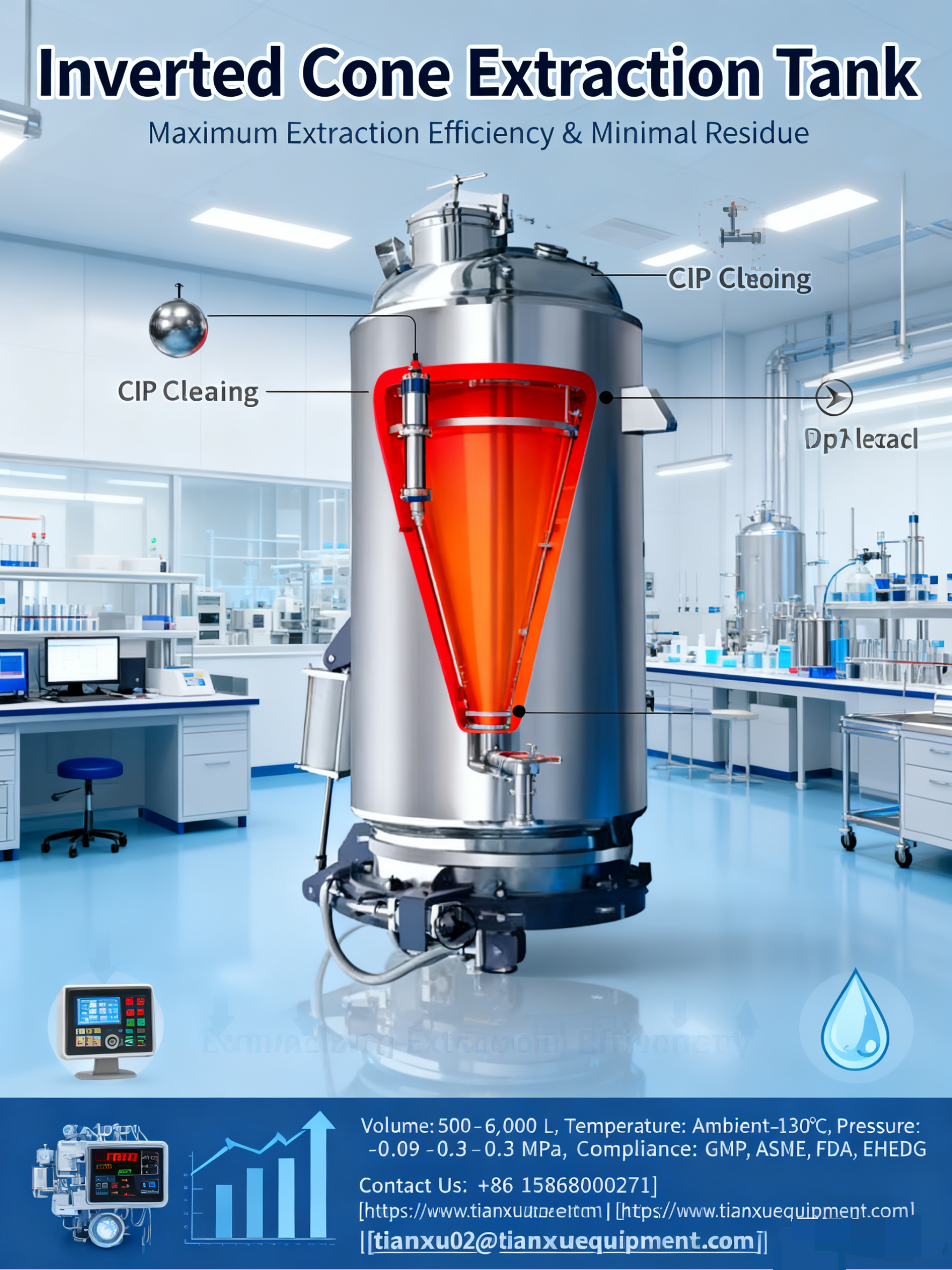
Clean-in-Place (CIP) and Sterilize-in-Place (SIP) integration remains non-negotiable for commercial labs. Modern sanitary systems require strategically placed CIP spray balls.
Following these strict sanitary protocols helps facilities pass rigorous regulatory validation easily. Sterilize-in-Place further introduces pure steam at 121°C. This guarantees a completely sterile processing environment before the next batch begins.
You must evaluate your facility footprint and utility availability very early. Extraction tanks often require massive ceiling clearance. Operators need this vertical space for biomass loading and unloading via overhead hoists. Concentrators demand substantial structural support due to their height and weight. They also require highly specific facility utility sizing. You must properly size your steam boilers, cooling towers, and compressed air systems before the equipment arrives.
Solvent recovery economics can make or break an operation. Condensing ethanol vapor requires massive heat removal. A credible concentration system should recover 90% to 95% of your ethanol. Poor condenser sizing leads directly to unseen vapor loss. If your cooling tower runs undersized, expensive vapor escapes the condenser entirely. This creates massive operational expenses over time.
Use this strict evaluation checklist when shortlisting equipment vendors:
You avoid costly integration delays when vendors provide complete, engineered solutions. Bare tanks require custom piping onsite, which inflates your installation budget and timeline.
Sizing a complete processing line demands careful, holistic balancing. You must weigh thermal limits, liquid flow rates, and facility utility loads accurately. We strongly advise against evaluating your extractor and your concentrator in isolated silos. They must function as a synchronized pair. Prioritize engineering vendors who design the sanitary piping, thermal transfer, and solvent recovery as one unified, closed-loop system.
As a recommended next action, define your process math immediately. Calculate your specific botanical-to-solvent ratio. Map out your ideal target shift times and daily biomass volume. Once you determine your required evaporation rate in liters per hour, you can request accurate equipment quotes with confidence.
A: Yes, dynamic extraction tanks can be fitted with external condensers for vacuum concentration. However, this severely bottlenecks overall throughput. It ties up your primary extraction vessel during the long, slow evaporation phase. Process engineers only recommend this dual-use setup for pilot-scale or laboratory environments, not for continuous commercial production.
A: Properly calibrated industrial units typically recover 90% to 95% of solvents like ethanol. This recovery percentage depends heavily on your facility's cooling tower efficiency and the applied vacuum depth. Efficient, over-sized condensation prevents valuable solvent vapor from escaping into the facility atmosphere.
A: You calculate the heating area based on the latent heat of vaporization of your specific solvent. Water requires much different thermal inputs than ethanol. You must also factor in the desired evaporation rate (L/hr) and the exact temperature differential between the steam heating medium and the boiling liquid.
A: Yes. Fibrous roots perform entirely differently than fine botanical powders. This dictates the specific type of false-bottom filtration required inside the extraction tank. Biomass type also influences the potential viscosity challenges your concentrated fluid will face during the final evaporation phase.