Please Choose Your Language


Views: 0 Author: Site Editor Publish Time: 2026-04-20 Origin: Site


Specifying process equipment involves high capital expenditure and massive operational stakes. You are essentially designing the heartbeat of your facility. We often view the Heating Mixing Tank as a critical bottleneck or a powerful accelerator for plant production. Incorrect sizing or poor specification quickly leads to compromised batches. You might face higher energy costs and fail strict compliance audits. Why does this matter? Fixing a poorly specified vessel after installation is incredibly costly. It severely disrupts your supply chain and compromises product integrity. Our goal is to guide you through this complex purchasing decision safely. We will provide an engineering-aligned, objective framework. You will learn how to evaluate and shortlist equipment effectively. By the end, you will know how to match a tank perfectly to your exact process, regulatory compliance, and facility constraints.
Utility infrastructure (steam, electric, or thermal fluid) heavily dictates the operational cost and feasibility of specific heating jackets.
Agitation systems must be strictly paired with product rheology and viscosity changes during the thermal cycle to prevent product burning or uneven mixing.
Total Cost of Ownership (TCO) extends beyond the purchase price to include automation integration, Clean-in-Place (CIP) compatibility, and routine maintenance downtime.
Factory Acceptance Testing (FAT) and verifiable regulatory compliance (e.g., ASME, FDA, cGMP) are non-negotiable criteria when evaluating manufacturers.
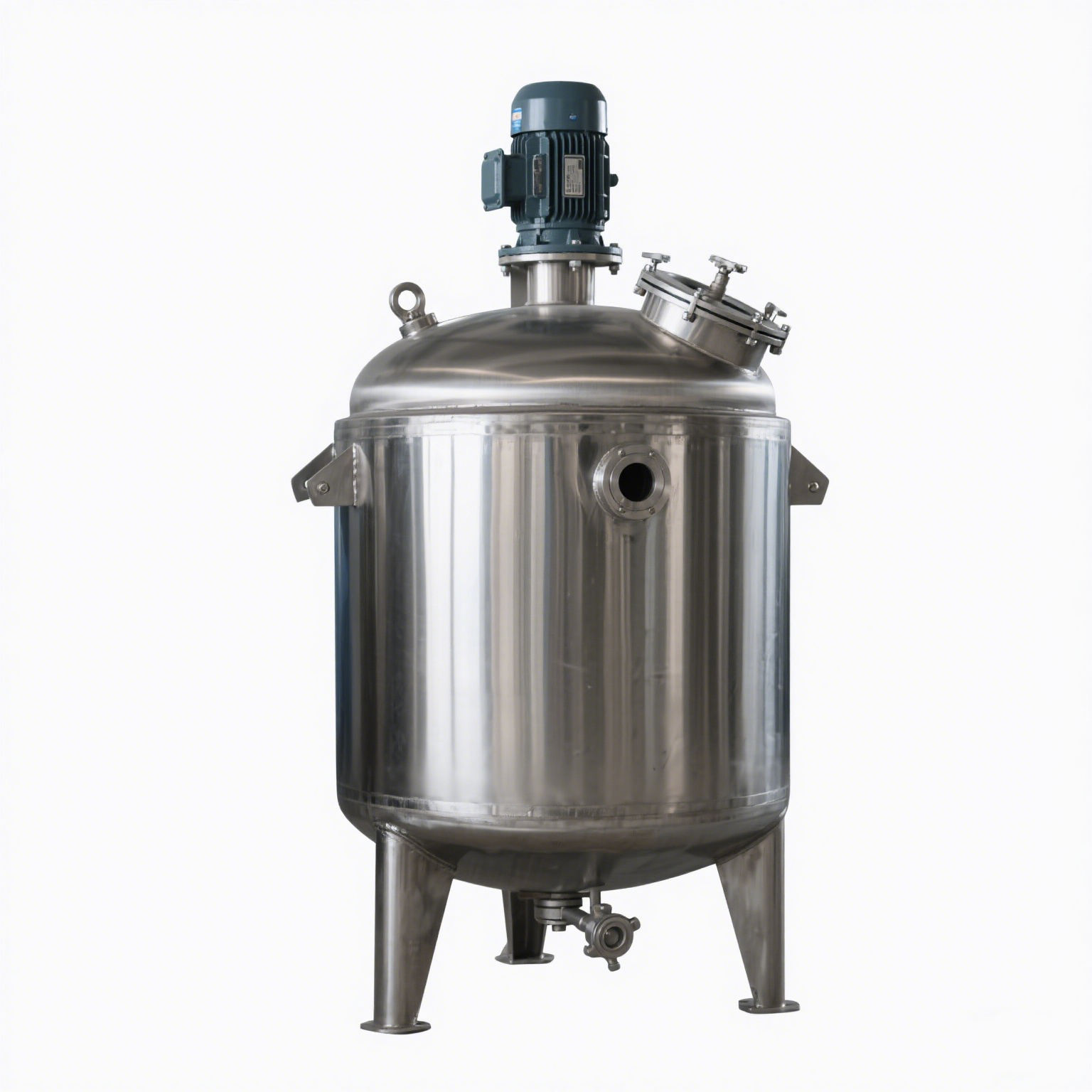
You must understand your fluid dynamics completely before contacting a manufacturer. A vague specification always results in poor equipment performance. We rely on precise math and clear process mapping to build a successful tank geometry.
Many buyers confuse total vessel volume with functional working capacity. This is a common and expensive mistake. If you purchase a 500-gallon vessel, you cannot safely process 500 gallons of liquid. Vigorous agitation creates a vortex. This vortex pushes the liquid level upward. Furthermore, heating a fluid causes thermal expansion. The product will overflow if you fill the tank to the brim. We always recommend sizing the optimal functional batch size at 75% to 80% of the total vessel volume. This provides adequate freeboard space for safe boiling, mixing, and ingredient additions.
Understanding your thermal requirements ensures you do not undersize the heating jacket. You must establish your Delta-T. This represents the required temperature change over a specific time. Ask yourself a few critical questions. How fast do you need to reach your target holding temperature? Do you need a rapid 20-minute ramp-up? Fast heating requires massive surface area and robust utility support. Once heated, how precisely must you hold that target temperature? Finally, determine your cool-down requirements. Some processes require rapid chilling immediately after cooking to stop chemical reactions.
Fluids rarely behave the same way across a wide temperature spectrum. You must document how your product behaves at different thermal stages. A thick syrup might thin out quickly when heated. Conversely, a polymer might cure and thicken massively as it cools down. These rheology shifts directly dictate your motor sizing and torque requirements. If you size a motor based solely on the hot, thin state, it will stall when the product cools and thickens. We map these viscosity curves carefully to guarantee the agitator can handle the heaviest processing phase.
The heating jacket is the thermal engine of your vessel. We match the jacket design strictly to the utility media you plan to use. Using the wrong jacket type leads to poor heat transfer and structural failures.
Manufacturers spot-weld a dimpled outer shell directly to the inner vessel. The dimples create intense fluid turbulence. Turbulence vastly improves heat transfer efficiency. Dimple jackets are highly ideal for steam and cooling water applications. They offer excellent heat transfer for moderate pressures. We recommend them for standard heating and mixing tank applications where weight and efficiency are priorities.
This design utilizes split pipes welded continuously in a spiral around the tank exterior. Half-pipe jackets handle incredibly high pressures safely. They also provide massive structural rigidity to the primary vessel wall. They are best suited for high-temperature thermal fluids (hot oil). They keep high-velocity fluids channeled tightly against the tank wall.
A conventional jacket features a simple outer wall enclosing a large annular space. We find this design appropriate for smaller batch sizes. It works well for low-pressure heating or cooling applications. Because it lacks complex flow paths, it is easier to manufacture but less efficient at transferring heat rapidly across large volumes.
Selecting the right heating utility drives your infrastructure design. Let us review the primary options available.
Heating Media | Infrastructure Complexity | Heat Transfer Speed | Best Application Scenario |
|---|---|---|---|
Electric | Low Upfront | Moderate | Facilities without existing boilers; highly localized setups. |
Steam | High (Requires Boiler) | Very Fast | Large scale plants needing highly responsive, rapid heat. |
Thermal Fluid (Oil) | Moderate to High | Steady & Extreme | Achieving very high temperatures without extreme vapor pressures. |
Electric heating offers lower upfront installation complexity. It is ideal for facilities lacking existing boilers. However, it can generate higher localized operational utility bills. Steam provides incredibly fast, highly responsive heat transfer. It strictly requires existing plant boiler infrastructure. Thermal fluid, or hot oil, remains best for achieving very high temperatures. It completely avoids the extreme, dangerous pressures typically associated with high-heat steam systems.
Agitation systems must strictly pair with your product characteristics. Poor mixing destroys product quality. We rely on distinct agitator styles to handle specific fluid behaviors.
Viscous products naturally cling to the heated vessel wall. They will quickly scorch and burn if left stationary. Anchor agitators with Teflon scrapers are absolutely essential for these applications. The scrapers physically wipe the inner tank wall continuously. They remove product from the heat source instantly. This action prevents burn-on completely. It ensures highly uniform heat distribution throughout the entire batch.
Some processes demand aggressive mechanical force. You might need to create stable emulsions. You may need to dissolve stubborn powders into liquids quickly. High-shear dispersers spin at extreme speeds. They generate intense mechanical and hydraulic shear. This force reduces particle sizes dramatically during the heating phase. We use them for cosmetics, sauces, and complex chemical slurries.
These represent highly cost-effective solutions for straightforward applications. We use them primarily for low-viscosity, simple liquid-liquid blending. They also perform beautifully for basic solid suspension. Propellers create excellent axial flow. They fold the liquid over itself efficiently without consuming massive amounts of power.
Complex rheologies often require multiple mixing actions simultaneously. We evaluate dual or triple-shaft mixers for these difficult products. A dual-shaft configuration usually combines a slow-moving anchor with a high-speed disperser. The anchor provides macroscopic flow. It moves the thick bulk mass toward the center. The high-shear blade provides microscopic dispersion. It crushes agglomerates instantly. Together, they handle the most demanding formulations.
Best Practices for Agitation Selection
Always match the motor horsepower to the highest anticipated viscosity during the thermal cycle.
Install variable frequency drives (VFDs) to allow operators to adjust speeds as the product changes consistency.
Ensure the agitator shaft features a sanitary mechanical seal to prevent contamination.
The physical materials comprising your vessel determine its lifespan and safety. You cannot cut corners here. Regulatory bodies scrutinize material choices strictly.
You must assess the necessity of 304L versus 316L stainless steel. We base this decision on product acidity, chloride content, and required corrosion resistance. Standard 304L handles basic water and mild food ingredients easily. However, highly salty or acidic products will pit 304L quickly. We upgrade to 316L stainless steel for these environments. Furthermore, highly aggressive specialty chemicals often require exotic alloys. We regularly specify Hastelloy to survive extreme chemical attacks.
A rough interior surface harbors dangerous bacteria. We define surface smoothness using Ra (Roughness Average) values. Pharmaceutical (cGMP) and food-grade applications require ultra-smooth finishes. Lower Ra numbers indicate a smoother surface. We mandate mechanical polishing followed by electropolishing for sanitary vessels. Electropolishing removes microscopic metal peaks. It creates a passive, highly sterile surface. This prevents bacterial colonization entirely.
Application Standard | Typical Ra Value (Microinches) | Finishing Method |
|---|---|---|
Standard Industrial | 32 Ra or higher | Standard Mill Finish / Basic Polish |
Sanitary Food & Beverage | 15 - 32 Ra | Mechanical Polish |
Pharmaceutical (cGMP) | 15 Ra or lower | Mechanical Polish + Electropolish |
Manual tank cleaning wastes massive amounts of production time. Clean-in-Place (CIP) and Sterilize-in-Place (SIP) systems minimize turnaround time between batches. You must ensure the tank includes properly placed interior spray balls. These must cover every internal surface. Design the tank with self-draining sloped or conical bottoms. Use only sanitary fittings, such as Tri-Clamps. Eliminate all dead legs where stagnant fluid could hide and putrefy.
Verifiable regulatory compliance is non-negotiable. Verify that your manufacturer can provide comprehensive documentation. Pressurized heating jackets absolutely require ASME certification in the United States. In Europe, they require CE/PED documentation. Food and pharmaceutical applications require FDA material compliance for all gaskets and seals. Finally, ensure any electrical control panels carry UL or CSA listings. Missing certifications will halt your production during an inspection.
Purchasing the hardware is only the first phase. Integrating a massive steel vessel into an active facility presents profound engineering challenges. We must assess physical constraints and utility demands deeply before placing an order.
Physical space dictates your equipment design. Measure your ceiling heights carefully. Account for the additional height needed to safely remove the agitator shaft for maintenance. Measure all door clearances for rigging and installation. You cannot install a tank that will not fit through the loading bay. Furthermore, map your available floor space accurately. Mechanics require safe maintenance access around large motors and heavy discharge valves. Crowding the equipment creates severe safety hazards.
A powerful new tank demands heavy utility support. Confirm your facility has adequate electrical amperage available at the installation site. Large heating elements will trip undersized breakers instantly. Verify you have sufficient steam pressure from the central boiler. Check your compressed air lines if you plan to use pneumatic automated valves. You must support the new equipment seamlessly. Never starve your existing production lines of critical utilities.
Modern process vessels require smart control systems. You must decide how to run the batch. Standalone relay logic is simple but highly limited. Basic VFD control allows operators to turn dials manually. However, we highly recommend fully integrated PLC and HMI systems. These advanced panels tie directly into existing plant SCADA networks. They allow for precise automated recipe management. They also provide rigorous data logging. This data proves crucial for quality control audits and batch traceability.
Map out required inputs (temperature probes, level sensors).
Determine required outputs (motor speeds, valve positions).
Specify the communication protocol (e.g., Ethernet/IP, Modbus) to link with your main plant network.
Selecting the right vendor is just as important as selecting the right steel. You are choosing an engineering partner. Look for transparent communication and proven industrial experience.
Avoid vendors who strictly push off-the-shelf configurations. Your process flow is unique. Prioritize manufacturers who offer thorough custom engineering reviews. They should supply detailed 3D CAD models before manufacturing begins. This ensures the tank matches your exact piping locations. They must demonstrate a willingness to adapt nozzle sizes and locations to serve your facility.
Never accept delivery blindly. Demand a rigorous FAT protocol at the manufacturer's facility prior to shipping. Travel to the site if possible. Verify the agitation speeds under load. Test the thermal holding capacity using comprehensive water tests. Check every sensor. Ensure the control panel functionality meets your specifications precisely. Finding a flaw during FAT is a minor inconvenience. Finding a flaw after installation is a major crisis.
Industrial machinery experiences wear and tear. Evaluate the manufacturer’s warranty terms closely. Investigate the domestic availability of critical wear parts. You will eventually need replacement mechanical seals, Teflon scrapers, and bearings. If parts ship from overseas, your plant might sit idle for weeks. Finally, test their technical support response times. You need a partner who answers the phone quickly when an emergency arises.
Purchasing process equipment remains a complex exercise in balancing thermodynamic requirements with mechanical capability. You must align your facility infrastructure with the chosen heating medium. You must match the agitator precisely to the product's shifting viscosity.
Reiterate the importance of bringing precise product data into your initial vendor conversations. Bring clear viscosity numbers, density figures, and temperature curves to the table. Vendors rely on this data to engineer a tank that works perfectly from day one.
Do not leave your plant's efficiency to chance. Consult with a dedicated process engineering specialist today. Request a custom engineering quote based purely on your specific, documented batch parameters.
A: A dimple jacket uses a spot-welded outer shell to create turbulence, offering excellent heat transfer for moderate pressures. A half-pipe jacket utilizes continuous spiral piping welded to the tank. It provides superior structural rigidity and safely handles extreme pressures and high-temperature thermal fluids.
A: You prevent burn-on by utilizing an anchor agitator equipped with Teflon surface scrapers. These scrapers continuously wipe the heated vessel walls. They remove thick, stationary product from the heat source instantly. Carefully controlling the temperature differential (Delta-T) also prevents aggressive localized scorching.
A: Yes. Many standard jackets can circulate chilled water or glycol immediately post-heating. For complex processes, we utilize dual-zone jackets. These allow operators to shut off the steam supply, purge the jacket, and introduce a cooling medium to drop the batch temperature rapidly.
A: Custom manufacturing typically takes between 12 to 24 weeks. This industry lead time depends heavily on material availability, specific alloy requirements, and overall design complexity. Thorough engineering approvals, rigorous FAT procedures, and securing specialized automation components often extend the total project timeline.