Please Choose Your Language


Views: 0 Author: Site Editor Publish Time: 2026-04-22 Origin: Site


Process engineers and procurement teams constantly face a critical equipment dilemma. You must choose between standard mixing vessels and thermally integrated units without jeopardizing your process. Over-specifying a mixing vessel inflates utility demands and complicates daily plant operations. Conversely, under-specifying your equipment leads to ruined batches, clogged discharge pipelines, or failed emulsions. This crucial decision goes far beyond basic equipment definitions. We will provide a strict, engineering-first comparison to help you evaluate your true formulation needs. You will learn exactly when ambient mechanical agitation is sufficient for your production line. We will also explore when complex thermal integration becomes an absolute engineering necessity. By understanding fluid dynamics and system integration requirements, you can make a highly informed technical choice. Our guide eliminates the guesswork from your equipment sizing and specification process.
The primary physical distinction lies in the wall design: standard tanks are single-wall vessels for ambient mixing, while heating mixing tanks utilize jacketed structures for precise thermal transfer.
Process formulation dictates the choice: high-viscosity materials, wax-based cosmetics, and temperature-sensitive active ingredients mandate a heating and mixing tank.
Sizing rules change with heat: heated processes strictly require 20% to 40% headspace to accommodate thermal expansion and foaming.
Heating transitions the equipment from a standalone component to an integrated system requiring boilers, chillers, and advanced sensor loops.
Understanding the fundamental architectural differences between vessel types ensures you select the correct equipment for your specific fluid dynamics. We must look beyond mere capacity and examine the mechanical construction of the tank walls.
Manufacturers construct standard mixing tanks using a single layer of stainless steel. Engineers design these vessels strictly for physical blending tasks. They do not alter the ambient temperature of the internal materials. A standard tank relies entirely on the mechanical kinetic energy generated by the agitator blade. You will find these units operating in environments where the facility's ambient room temperature matches the required processing temperature.
These single-wall vessels excel in specific, straightforward applications. They are ideal for pure liquid-to-liquid blending where both phases are highly miscible. You can also use them for dry powder dissolution into low-viscosity fluids. Formulations that respond well to aggressive mechanical agitation often thrive in standard tanks. If your process uses high-speed turbine or propeller agitators, and the materials do not require thermal assistance to flow, a standard tank remains your most efficient option.
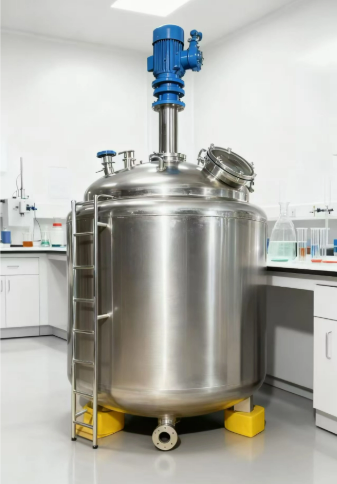
The Heating Mixing Tank introduces profound structural complexity. It features a double or triple-wall structure. The design incorporates an internal jacket for the heating medium and an external insulated layer to protect operators. This architecture transforms the vessel into a highly controlled thermodynamic environment.
Industry standards dictate specific heating medium thresholds based on total capacity. Tanks under 1,000 liters typically utilize electric heating rods. These rods submerge into a thermal fluid bath within the jacket, providing highly efficient energy transfer for smaller footprints. However, vessels exceeding 1,000 liters usually require direct steam heating. Steam ensures rapid, uniform thermal distribution across massive surface areas, preventing cold spots in large industrial batches.
Furthermore, heated vessels demand strict pressure and vacuum ratings. Heating operations, especially within cosmetics or pharmaceuticals, release volatile gases. They often require vacuum-rated enclosed designs. Unlike standard open-top tanks, a vacuum-rated heating vessel prevents oxidation. It also pulls microscopic bubbles out of the mixture during thermal emulsification, ensuring absolute product stability.
Engineering Feature | Standard Mixing Tank | Heating Mixing Tank |
|---|---|---|
Wall Architecture | Single-layer stainless steel | Double/Triple-wall (Jacketed & Insulated) |
Energy Source | Mechanical motor only | Motor + Thermal Medium (Steam/Electric) |
Vessel Enclosure | Often atmospheric or open-top | Typically enclosed, pressure/vacuum rated |
Primary Function | Ambient physical blending | Thermodynamic state alteration & emulsification |
Your formulation's specific chemistry and rheology must dictate your equipment choice. You cannot force a highly viscous or temperature-sensitive material into a standard ambient vessel without risking severe product degradation.
Standard tanks struggle immensely with high-viscosity materials. When you process heavy syrups, thick lotions, or dense pastes at ambient temperatures, the fluid resists movement. This resistance causes severe motor strain. It also creates large dead zones near the tank walls where material remains entirely unmixed. High-viscosity fluids simply do not flow adequately without thermal intervention.
A heating and mixing tank solves this problem by manipulating the material's physical state. Applying heat lowers the overall material viscosity through thermal transfer. The fluid becomes less resistant and flows freely. This state change allows heavy-duty anchor or ribbon agitators to achieve perfectly homogenous mixtures. You accomplish this without relying on destructive high-shear forces that might otherwise damage the product.
Many advanced formulations contain highly shear-sensitive compounds. You frequently encounter these delicate ingredients in biopharmaceutical production and premium cosmetics. If you attempt to mix these compounds in a standard tank, you must use aggressive mechanical agitation to force uniformity. This aggressive sheer physically tears and damages complex molecular structures, rendering the active ingredients useless.
Thermal integration provides a gentle alternative. Applying precise heat allows for slow, low-speed mixing. We refer to this as gentle blending rather than aggressive mixing. The heat ensures the ingredients melt and incorporate naturally. You achieve the exact same uniformity while fully protecting the product’s delicate molecular integrity.
Standard tanks cannot facilitate phase changes. If your manufacturing process requires melting solid fats, heavy waxes, or solid butters into a liquid state, an ambient vessel will fail completely. Thermal integration is non-negotiable for phase-change chemistry.
Additionally, many food and beverage applications require strict microbial control. If your process mandates pasteurization, you must execute strict temperature holds to eliminate bacteria. For instance, you might need to keep a water-based solution above 160°F for thirty minutes before electronic mixing valves drop the output temperature for safe discharge. You can only achieve these validated thermal hold times within a heavily insulated, jacketed vessel.
Best Practices for Formulation Evaluation
Always review your Material Safety Data Sheet (MSDS) for flash points before applying heat.
Test your fluid's rheology at ambient versus elevated temperatures to calculate exact viscosity drops.
Consult your microbiologist to determine exact pasteurization holding times required for your industry.
Sizing a thermally integrated vessel requires entirely different mathematics than sizing a standard ambient tank. If you apply standard sizing logic to a heated process, you will encounter dangerous physical constraints.
We must strongly warn buyers against matching total tank volume directly to their target batch size. Standard tanks possess highly forgiving fill tolerances. You can often fill them to 90% capacity without issue. However, a jacketed vessel processing heated materials requires strict volumetric discipline.
You must reserve exactly 20% to 40% of the tank's total volume as empty headspace. This critical safety margin absorbs the inevitable thermal volume expansion that occurs when liquids heat up. Furthermore, many chemical reactions and emulsification processes produce volatile foaming during rapid heating cycles. Without adequate headspace, the expanding foam will breach the manway, clog the vacuum lines, and cause a severe operational hazard.
Facility layout often dictates standard tank shapes. You can order standard tanks that are unusually tall or excessively wide simply to fit a tight facility footprint. Ambient mixing relies on the agitator blade to move fluid, so unconventional shapes are manageable.
Heated tanks do not offer this geometric luxury. They perform best at a strict 1:1 to 1.2:1 height-to-diameter aspect ratio. This specific geometric proportion ensures optimal and uniform heat transfer across the entire jacketed surface area. If a heated tank is too tall and narrow, the heating medium cannot maintain a uniform temperature from the bottom cone to the upper side walls. You will inevitably create localized cold spots.
Fluid dynamics within a heated environment require strict directional control. Heated tanks rely heavily on internally welded baffles. These long metal plates attach vertically to the inner tank walls.
Baffles intentionally break the fluid's natural rotational momentum.
They stop the liquid from simply swirling in a uniform circle alongside the agitator.
They force the internal material to move continuously from the center shaft toward the heated outer walls.
This forced radial movement prevents material from stagnating against the hot steel. Without proper baffle integration, viscous materials will sit against the hot jacket and suffer localized burning, ruining the entire batch.
Procuring a thermally integrated vessel alters your entire facility's engineering footprint. You must shift your perspective from buying a single piece of equipment to implementing a complex, interconnected utility system.
A standard single-wall tank is a simple, standalone component. You place it on the floor, connect the electrical drop for the motor, and begin production. A heated tank, conversely, operates as the heart of an integrated thermodynamic system. It cannot function in isolation.
You must integrate extensive peripheral equipment to support the vessel. Steam-heated vessels require appropriately sized industrial boilers and extensive steam trapping manifolds. Furthermore, if you heat a product, you must usually cool it down before packaging to prevent container deformation. This requires integrating heavy-duty industrial chillers and automated temperature control loops to manage the thermal cycling. You must plan for this extensive infrastructure footprint.
You cannot guess on steel grades when engineering a heated system. For standard ambient food mixing, 304 stainless steel usually provides adequate protection. However, thermal integration fundamentally alters the chemical aggression of your ingredients.
Elevated temperatures exponentially accelerate metallic corrosion. This degradation happens rapidly if your formulation contains high levels of chlorides, specialty salts, or acidic compounds. Subjecting 304 stainless steel to hot chlorides leads to severe stress corrosion cracking. Therefore, heated applications frequently mandate the superior metallurgical properties of 316L stainless steel. The addition of molybdenum in 316L provides the necessary resilience against hot, corrosive environments.
Equipment maintenance complexity scales dramatically with thermal integration. Standard single-wall tanks feature smooth, accessible interiors that operators can clean quickly. Jacketed tanks operate under much tighter sanitary constraints.
Heated vessels often feature complex internal heating coils, scraping agitator blades, and highly sensitive vacuum seals. When viscous materials bake onto hot inner walls, they become incredibly difficult to remove. You must implement rigorous, validated Clean-in-Place (CIP) protocols. These automated CIP systems utilize high-pressure spray balls and hot caustic chemicals to prevent bacterial cross-contamination. You must account for this increased operational downtime during your production scheduling.
Common Mistakes in System Integration
Engineers often fail to calculate the cooling capacity required after a heating cycle. Pumping hot product directly into plastic packaging causes the bottles to melt and warp. Always ensure your chiller system can reduce the batch temperature to safe packaging thresholds within your required cycle time.
To streamline your engineering decisions, we have categorized the absolute thresholds for both equipment types. Use this logic to defend your final specifications to your operations team.
You should specify a single-wall ambient tank when your process aligns with the following conditions:
Formulations are purely aqueous: Your product consists primarily of water and non-viscous liquids.
Ingredients are fully soluble at room temperature: Your powders and additives dissolve completely without thermal assistance.
Utility infrastructure is unavailable: Your facility lacks access to industrial steam boilers or high-amperage electrical drops needed for thermal fluids.
No phase changes occur: Your raw materials arrive in a liquid state and remain in a liquid state throughout the process.
You must specify a jacketed, thermally controlled vessel when your production process demands the following:
Emulsifying oil and water phases: Cosmetics, lotions, and advanced creams require strict thermal control to bind opposing phases effectively.
Pasteurization compliance: Your food or beverage product must meet strict GMP standards for thermal microbial destruction.
Hot pump-out requirements: Your product (like wax, heavy resin, or caramel) will solidify in the discharge pipelines if it drops to ambient temperature.
Vacuum degassing: Your thick emulsion traps micro-bubbles that you must pull out under heated vacuum conditions to prevent rapid oxidation.
Decision Matrix Summary
Process Requirement | Standard Tank | Heated Tank |
|---|---|---|
Low Viscosity / High Miscibility | Highly Recommended | Over-specified |
Phase Change (Solid to Liquid) | Cannot Perform | Mandatory |
Shear-Sensitive Active Ingredients | High Risk of Damage | Highly Recommended |
Sterilization / Pasteurization | Cannot Perform | Mandatory |
Your ultimate equipment selection must remain entirely subordinate to your fluid dynamics, ingredient chemistry, and facility utility limits. Choosing between ambient and heated vessels dictates the fundamental success of your daily production runs. You must evaluate the sheer sensitivity of your active ingredients and the flow behavior of your final product.
We strongly advise engineering and purchasing teams to review their material safety data sheets (MSDS) and rheology profiles thoroughly before requesting manufacturer quotes. Understand your exact viscosity at various temperatures to properly size your agitator motors and heating jackets.
Take proactive action today. Encourage your team to consult with a systems-focused equipment manufacturer. Request a pilot test for your most difficult formulation, or ask them to audit your existing thermal parameters. A proper engineering audit ensures your facility operates safely, efficiently, and consistently.
A: No. Wrapping a single-wall tank with aftermarket heating bands is highly inefficient and physically unsafe. True thermal mixing requires a specifically engineered, pressure-rated jacket and a thick insulation layer. This built-in architecture distributes heat evenly across the steel surface and prevents operators from suffering severe burns.
A: Electric heating uses internal elements to heat a thermal fluid trapped inside the jacket. It is ideal for smaller batches under 1,000 liters and facilities lacking a boiler. Steam heating injects live steam directly into the jacket. It offers much faster temperature ramp-up times and provides superior efficiency for high-capacity industrial tanks.
A: High temperatures frequently cause volatile outgassing or trap micro-bubbles inside thick, viscous mixtures. A vacuum-rated, enclosed tank uses negative pressure to pull these destructive bubbles out of the emulsion. This prevents long-term oxidation and ensures shelf stability. A standard open-top tank simply cannot hold a vacuum.