Please Choose Your Language


Views: 0 Author: Site Editor Publish Time: 2026-04-09 Origin: Site


Selecting the right mixing tank for a production line is one of the most critical decisions in industrial manufacturing. Whether operating in the food and beverage, pharmaceutical, cosmetic, chemical, or biotechnology sectors, the mixing tank is more than a simple container—it is the heart of the production process. It ensures the homogeneity of ingredients, facilitates chemical reactions, maintains product quality, and contributes to overall operational efficiency. Choosing an inappropriate tank can lead to inconsistent products, process inefficiencies, increased energy consumption, regulatory compliance challenges, and even safety hazards.
A well-designed mixing tank integrates key elements such as precise temperature control, appropriate agitation, hygienic construction, and automation. Understanding the factors that influence mixing tank performance enables manufacturers to make informed decisions, optimize production, and ensure regulatory compliance. This guide explores the critical considerations for selecting the ideal mixing tank for your production line, providing a comprehensive resource for engineers, plant managers, and industrial decision-makers. Additionally, we highlight how collaborating with an experienced manufacturer like Wenzhou Tianxu Machinery Technology Co., Ltd. can enhance equipment reliability and operational outcomes.
A mixing tank is designed to combine two or more substances into a uniform mixture. Its applications vary across industries: in food and beverage, it ensures consistent flavor, texture, and appearance; in pharmaceuticals, it guarantees uniform active ingredient distribution; in cosmetics, it preserves the stability and performance of formulations; and in chemicals, it allows precise reactions and product consistency. Unlike storage tanks, mixing tanks are equipped with agitation systems that actively blend contents, achieving uniformity and preventing separation.
Mixing tanks come in various configurations tailored to specific industrial needs. Common types include:
Standard agitated tanks: used for general blending, often equipped with mechanical stirrers.
Jacketed tanks: designed for precise heating or cooling.
High-shear mixers: suitable for emulsions or dispersions of powders and liquids.
Sanitary tanks: compliant with food and pharmaceutical hygiene standards.
Pressure or vacuum tanks: used for controlled chemical reactions or to prevent contamination.
The choice depends on the nature of materials, required process control, production scale, and regulatory requirements.
Material compatibility is the foundation of sanitary tank performance. Stainless steel is widely favored for its corrosion resistance, durability, and compliance with food and pharmaceutical regulations. Grades 304 and 316 are common, with 316 providing enhanced resistance to aggressive chemicals and high-temperature applications. For chemical manufacturing, specialized alloys or coated carbon steel may be necessary to withstand corrosive or reactive substances.
Sanitary tanks require polished surfaces with minimal roughness, typically Ra 0.4 microns or lower, to prevent bacterial growth and facilitate cleaning. Seamless welds and hygienic fittings reduce contamination risk and ensure compliance with FDA, GMP, EHEDG, or 3A standards. Surface quality directly impacts both product safety and cleanability.
High-quality materials increase tank longevity, reduce maintenance costs, and maintain performance over time. Resistance to pitting, rust, and chemical degradation ensures the tank remains reliable through repeated use and cleaning cycles. Choosing durable materials minimizes downtime and protects both product integrity and regulatory compliance.
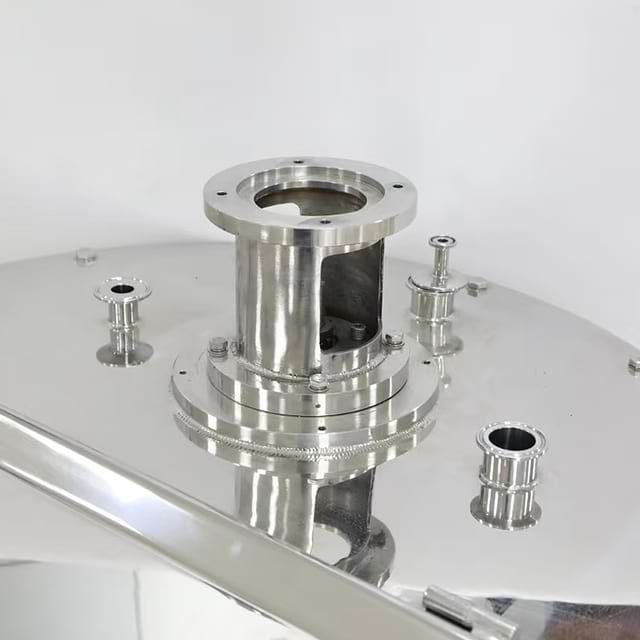
The tank must accommodate the required batch size while ensuring proper mixing dynamics. Undersized tanks necessitate multiple batches, reducing efficiency and increasing labor. Oversized tanks may create low fluid velocities, leading to poor mixing and energy inefficiency. Understanding production volumes is key to selecting the appropriate tank size.
Future growth must be considered when selecting tank capacity. A slightly larger or modular tank can accommodate increased production without requiring a complete system overhaul. This ensures long-term operational flexibility and cost-effectiveness.
Physical dimensions must fit within the available production area. Ceiling height, floor loading capacity, and access for maintenance and cleaning all influence tank selection. Proper integration with piping, pumps, heating, and automation systems is essential for smooth operation.
The type of impeller significantly affects mixing efficiency. Radial flow impellers create turbulence for low-viscosity liquids, while axial flow impellers provide gentle circulation for delicate formulations. Ribbon, paddle, or anchor impellers handle high-viscosity or semi-solid products. High-shear impellers enable rapid dispersion and emulsification. Selecting the correct impeller ensures uniform mixing and preserves the integrity of sensitive ingredients.
The agitation motor must match the process requirements. High-viscosity fluids or dense materials require powerful motors, whereas low-viscosity liquids may operate efficiently with smaller drives. Variable speed control provides flexibility, allowing precise mixing adjustments during different stages of the process.
Effective circulation prevents dead zones and uneven mixing. Baffles, scrapers, and strategically placed impellers ensure all components achieve a uniform blend. This is particularly important for formulations containing multiple phases or heat-sensitive ingredients.
Temperature control is essential for maintaining product stability and facilitating reactions. Jacketed tanks allow for heating with steam, hot water, or oil, while chilled water, glycol, or refrigeration systems provide cooling. Consistent temperature ensures ingredient integrity, maintains viscosity, and supports chemical and biological processes.
Some processes require tanks to operate under pressure or vacuum conditions. Pressure-rated tanks enable controlled reactions and prevent contamination. Vacuum-assisted mixing can remove air bubbles from viscous formulations, improving consistency and quality.
Modern tanks feature automated temperature and pressure controls, enabling real-time adjustments and monitoring. Automation reduces human error, improves consistency, and supports data logging for regulatory compliance.
Sanitary tanks should include CIP capabilities for automated cleaning and sterilization. CIP systems reduce downtime, maintain hygiene, and minimize exposure of operators to cleaning chemicals.
Smooth, polished surfaces and seamless welds prevent bacterial growth. Valves, seals, and fittings must allow easy access for inspection and cleaning. Proper design ensures regulatory compliance and product safety.
Tanks must meet standards such as FDA, GMP, EHEDG, and 3A, depending on the industry. Compliance ensures safe, legal production and supports quality control initiatives.
Initial investment should be considered alongside long-term operational costs. High-quality materials, reliable agitation systems, and integrated controls may increase upfront costs but reduce maintenance, energy consumption, and product loss over time.
Regular inspections, lubrication, seal replacements, and cleaning schedules extend equipment lifespan. Tanks designed for easy maintenance reduce downtime and improve production efficiency.
Energy-efficient tanks incorporate insulated jackets, optimized impellers, and efficient heating/cooling systems. Reducing energy consumption lowers operating costs and supports sustainable manufacturing practices.
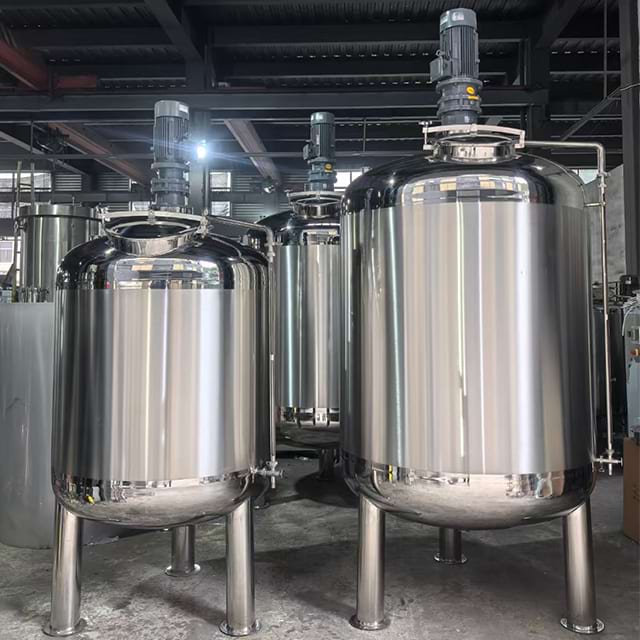
For dairy, beverages, sauces, and confections, temperature control, sanitation, and precise mixing are vital. CIP systems, polished stainless steel, and automation ensure product safety and consistent quality.
Pharmaceutical and biotech applications demand sterile operation, precise dosing, and regulatory compliance. Tanks must maintain controlled conditions for sensitive compounds, ensuring efficacy and safety.
High-shear mixing tanks provide rapid dispersion for emulsions, creams, and adhesives. Temperature and shear management are critical for stability, texture, and performance.
Chemical manufacturers require corrosion-resistant materials, pressure capabilities, and precise temperature management to maintain reaction consistency and product purity.
Selecting the right mixing tank for a production line requires careful evaluation of material quality, tank capacity, agitation systems, temperature and pressure control, sanitation, and regulatory compliance. Proper selection ensures consistent product quality, operational efficiency, and long-term reliability. Partnering with an experienced manufacturer like Wenzhou Tianxu Machinery Technology Co., Ltd. provides access to high-quality, tailored solutions. Their expertise in design, engineering, and support ensures that mixing tanks meet specific industrial needs, comply with regulatory standards, and deliver reliable, efficient, and sustainable production outcomes.
Q: What are the main factors to consider when buying a sanitary mixing tank?
A: Material quality, capacity, agitation system, temperature and pressure control, and sanitation are the critical factors.
Q: Why is automation important for mixing tanks?
A: Automation ensures precise control, reduces human error, supports regulatory compliance, and maintains consistent product quality.
Q: How does temperature control impact mixing operations?
A: Proper temperature management preserves ingredient integrity, maintains viscosity, and facilitates controlled chemical or biological processes.
Q: Can one mixing tank be used for multiple products?
A: Yes, if it meets hygiene, material compatibility, and regulatory requirements, but adjustments in agitation, temperature, or cleaning may be needed between batches.