Please Choose Your Language


| Quantity: | |
|---|---|


I. Product Overview:
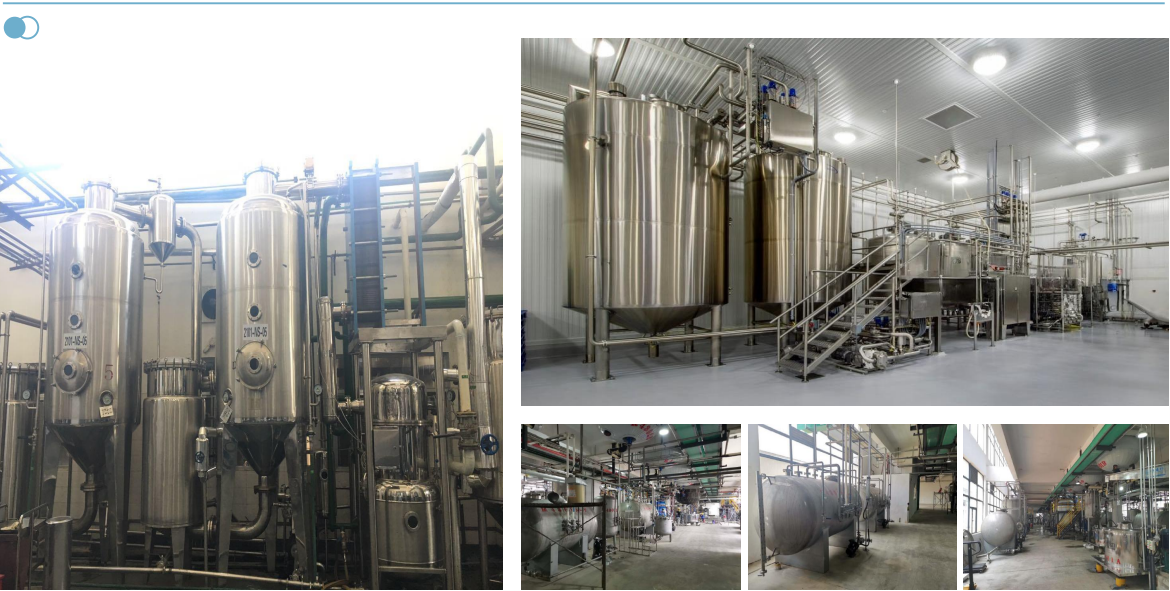
The hygienic vertical storage tank is designed for high-cleanliness scenarios, with core positioning of "sterile, no residue, corrosion-resistant, easy to clean", used for storing, temporarily keeping and transferring liquid materials requiring strict hygiene control.
Vertical-structured, it saves space (60% floor area of horizontal tanks), optimizes material inlet/outlet, reduces retention and improves efficiency.
Made of food/pharmaceutical-grade SUS304/SUS316L stainless steel, it is corrosion and high-temperature resistant (service life over 15 years). Its mirror-polished inner surface (Ra≤0.4μm, up to Ra≤4μm for high-end models) has no dead corners, avoiding residue and bacterial growth.
Compared with traditional tanks, it has upgraded sealing and cleaning convenience, with CIP interfaces for online cleaning/sterilization (no manual disassembly), reducing costs and avoiding secondary pollution to support standardized production.
II. Application Industries:
It covers food, medicine, biology, daily chemicals and other fields, and accurately matches the personalized storage needs of different industries.
1. Food and Beverage Industry: hygienic vertical storage tanks can be used for the storage and turnover of drinking water, fruit juice, dairy products, alcohol, condiments, edible oil and other materials. Whether it is the low-temperature temporary storage of dairy products, the sterile storage of fruit juice, or the aging turnover of alcohol, the equipment can perfectly ensure the freshness and purity of materials, prevent the mixing of miscellaneous bacteria and peculiar smells, conform to relevant standards such as GB 4806.9 in the food industry, and guard the bottom line of food safety.
2. Pharmaceutical and Biological Industry: It is suitable for the material storage needs of pharmaceutical, biological preparation, health product and other fields, and can be used for the sterile storage of liquid medicine, intermediates, fermentation broth, vaccines, serum and other materials. The equipment is designed and manufactured in strict accordance with GMP standards. The fully sealed structure can effectively isolate external pollution, and the mirror-polished inner wall has no residue, avoiding material deterioration and cross-contamination. At the same time, it can adapt to special working conditions such as high-temperature sterilization and low-temperature refrigeration, helping pharmaceutical enterprises achieve compliant production and ensure the quality and safety of drugs.
3. Daily Chemical and Beauty Industry: It is used for the storage of cosmetic stock solution, skin care product base materials, toiletries raw materials, etc., especially for sterile cosmetics and medical skin care products with high hygiene requirements. The equipment can effectively avoid raw material oxidation and pollution, maintain the activity and stability of raw materials, and its corrosion resistance can adapt to the storage needs of various daily chemical raw materials, helping enterprises create high-quality daily chemical products.
4. Other High-end Fields: In addition to the above industries, it is also widely used in fine chemical industry, new energy materials, laboratory research and development and other fields for the storage of high-purity liquids, special reagents, lithium battery electrolytes and other materials.

III. Technical Parameters:
The excellent performance of the hygienic vertical storage tank comes from every precisely controlled technical parameter. From material and volume to sealing and cleaning, every detail has been strictly calculated and optimized to ensure that the equipment adapts to the production needs of different industries, while taking into account safety, efficiency and compliance. The following are the general core technical parameters, which can be flexibly adjusted according to customer needs:
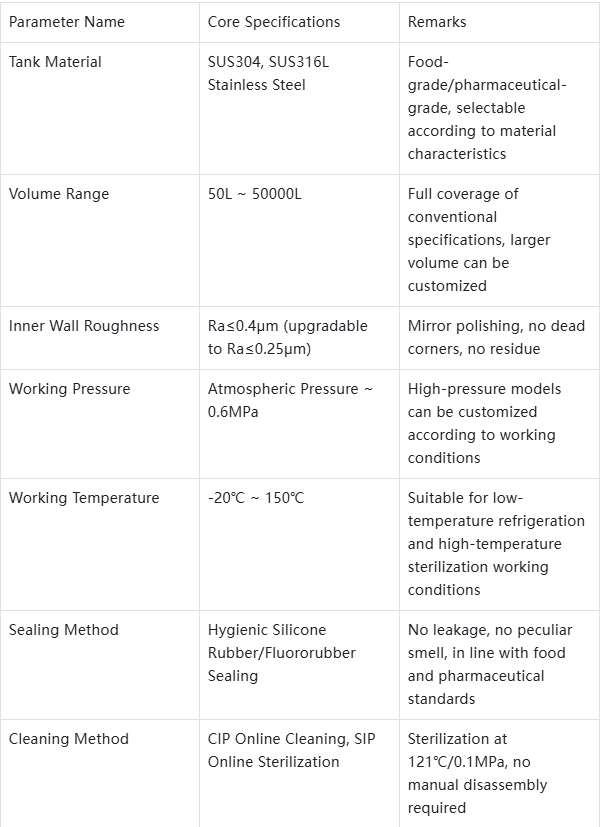
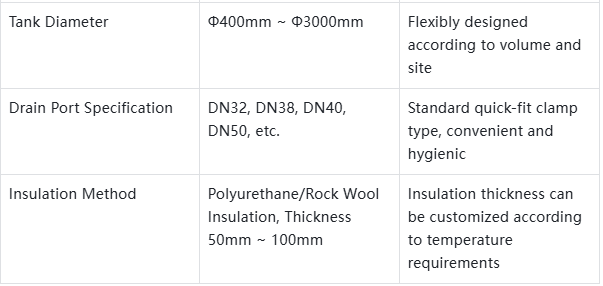
Note: The above are general parameters. For special materials (such as highly corrosive, high viscosity, and easily oxidizable materials), the material, sealing, structure and other parameters can be customized and optimized to ensure that the equipment is perfectly adapted to the production working conditions.
IV. Structural Design
The structural design of the hygienic vertical storage tank always centers on three core principles: "hygiene first, efficiency and convenience, and safety and stability". Every structural part has undergone repeated optimization, which not only meets the strict requirements of clean production, but also takes into account production efficiency and operational convenience, achieving the dual goals of "aesthetics and sturdiness".
1. Tank Structure: Adopting a vertical cylindrical design without sharp edges or angles, the transition section of the inner wall adopts an arc transition, which completely eliminates hygiene dead corners and avoids material residue and bacterial growth (a hygienic stirring device can be equipped as required).
2. Material and Surface Treatment: The tank body, inner tank and all components in contact with materials are made of SUS304 or SUS316L stainless steel, complying with the hygiene standards of the food and pharmaceutical industries. The inner surface adopts electrolytic mirror polishing technology, and the outer surface can be polished, sandblasted, frosted or cold-rolled matte treated according to requirements.
3. Sealing and Interface Design: It adopts a fully sealed structural design. The top of the tank is equipped with a hygienic breather valve and a sealing cover, which can effectively isolate external dust and various bacteria, balance the pressure inside the tank, and avoid material oxidation and deterioration. In addition, accessories such as liquid level gauges, thermometers, pressure gauges and safety valves can be equipped as required to realize real-time monitoring and safety protection of material storage.
4. Optimization of Auxiliary Structures: The bottom of the tank adopts a gradient design, which facilitates the complete discharge of materials without residue and avoids material waste; it is equipped with stable legs or lugs, and the bottom of the legs is provided with anti-slip and shock-absorbing pads to ensure stable operation of the equipment. For scenarios requiring thermal insulation, an insulation layer will be added outside the tank body, using polyurethane or rock wool insulation materials to effectively maintain the stable temperature of the materials in the tank and reduce energy loss; for working conditions requiring heating or cooling, a jacket structure can be added to realize temperature control of the materials.四、结构设计:
V. Manufacturing Standards:
From raw material procurement to finished product delivery, every link follows national and industry standards, and at the same time is in line with international norms, ensuring that the equipment meets the compliance requirements of various industries 。
1. Core Implementation Standards: Strictly follow the national and industry standards such as "Good Manufacturing Practice for Drugs (Revised in 2010)" (GMP), "Pressure Vessels (GB 150.1~150.4—2011)", "Steel Welded Atmospheric Pressure Vessels (NB/T47003.1—2009)", "Stainless Steel Thin-Walled Vessels for Food Industry (QB/T2681—2004)", and at the same time design and manufacture with reference to international standards such as ISO 9001 quality management system, ASME, PED, ensuring the hygiene, safety and compliance of the equipment.
2. Raw Material Control Standards: Raw materials are purchased from regular manufacturers of food-grade and pharmaceutical-grade SUS304 and SUS316L stainless steel. Each batch of raw materials must provide material certificates and test reports, and can be put into production only after passing sampling inspection, so as to prevent unqualified raw materials from entering the production link.
3. Finished Product Testing Standards: Before leaving the factory, each equipment must go through strict full-process testing, including material testing, sealing testing (water pressure testing, air tightness testing, test pressure is 1.5 times the design pressure), hygiene testing, dimensional accuracy testing, etc.
VI. Customization Capability:
There are differences in production working conditions, material characteristics and site conditions among different industries and enterprises. Conventional specifications of hygienic vertical storage tanks are difficult to fully adapt to all needs. Relying on a professional R&D and design team and a mature production system, we provide comprehensive and personalized customization services. From material and specification to structure and accessories, we provide one-to-one docking throughout the process to create exclusive equipment more suitable for customer needs, truly realizing "customization on demand and precise empowerment".
1. Material Customization: According to material characteristics, SUS304 and SUS316L stainless steel can be selected. For highly corrosive materials (such as strong acid and strong alkali), modified stainless steel or special alloy materials can be used to improve the corrosion resistance of the equipment; for high-purity materials, ultra-low carbon stainless steel can be selected to avoid the impact of materials on material purity.
2. Specification Customization: The volume can be customized from 50L to 50000L. The diameter and height of the tank body can be flexibly adjusted according to the size of the workshop site. At the same time, different structures such as single-layer, double-layer (with insulation layer) and three-layer (with insulation and jacket) can be customized to adapt to different working conditions such as low-temperature refrigeration, high-temperature sterilization and constant-temperature storage.
3. Structural Customization: According to the characteristics of materials and production processes, stirring devices (hygienic mechanical seals to avoid material pollution), jacket heating/cooling structures, vacuum sealing structures, etc. can be customized; for special site needs, non-standard legs, mobile bases, etc. can be customized to improve the flexibility and adaptability of the equipment.
4. Accessory Customization: CIP cleaning system, SIP sterilization system, liquid level alarm device, automatic temperature control system, weighing module, breather and other accessories can be equipped on demand to realize automatic and intelligent control of material storage; interface specifications can be customized according to the customer's existing pipeline system to ensure seamless connection between the equipment and the production line.
5. Full-process Service: The customization service covers the whole process of pre-sales technical consultation, scheme design, production and manufacturing, installation and commissioning, and after-sales maintenance. The professional technical team provides one-to-one docking, deeply understands customer needs, optimizes design schemes, timely feeds back progress during the production process, and invites customers to observe and test to ensure that the customized products fully meet expectations.
VII. Application Cases:
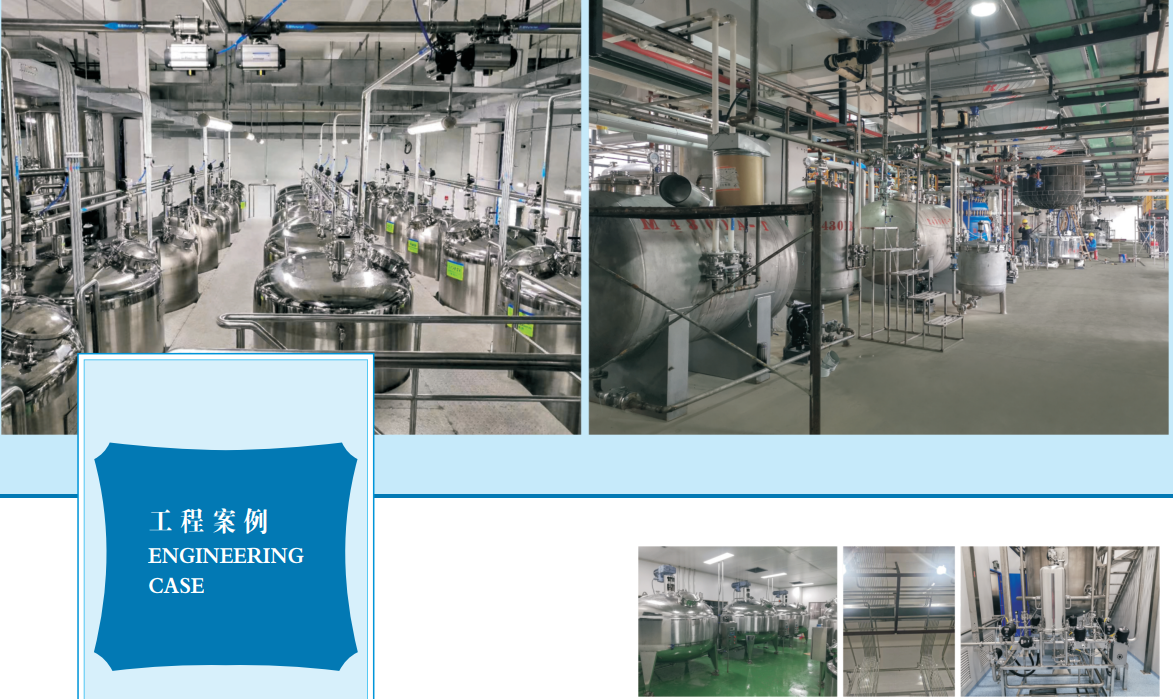
Over the years, with its excellent quality, strict hygiene standards and flexible customization capabilities, our hygienic vertical storage tanks have served thousands of enterprises across the country, covering food, medicine, biology and other fields, accumulated rich application cases, won the recognition and trust of customers with actual effects, and become the preferred equipment for clean production of many enterprises.
Case 1: Fujian Ronghua Food Co., Ltd
Demand: Need to store materials such as fresh milk and yogurt base, requiring the equipment to be sterile, no residue, easy to clean, adapt to low-temperature refrigeration working conditions, and at the same time need to be seamlessly connected with the existing production line, and the volume needs to meet the needs of mass production.
Solution: Customized 4 SUS316L stainless steel hygienic vertical storage tanks with volumes of 3000L and 8000L for it, equipped with low-temperature insulation layer (polyurethane insulation, thickness 80mm) to ensure stable storage of materials in a low-temperature environment of 2-8℃; adopted fully sealed structure and CIP online cleaning system to realize automatic cleaning and sterile sterilization, avoiding milk residue and miscellaneous bacteria pollution; the interface adopted quick-fit clamp design to seamlessly connect with the existing production line, and at the same time equipped with liquid level alarm and temperature monitoring device to grasp the material storage status in real time.
Application Effect: After the equipment is put into use, it completely solves the problems of inconvenient cleaning and easy deterioration of materials in traditional storage tanks. The milk storage cycle is extended by 30%, no pollution accidents occur, and the manual cleaning cost is reduced by 60% and the production efficiency is improved by 40%. It perfectly meets the hygiene standards and production needs of the dairy industry, has been highly recognized by customers, and has continued to place additional orders.
Case 2: Fangxin Pharmaceutical Technology Co., Ltd
Demand: Need to store materials such as liquid medicine and fermentation broth, requiring the equipment to meet GMP standards, be sterile, no cross-contamination, realize online sterilization, and at the same time adapt to high-temperature (121℃) sterilization working conditions. The material needs to be corrosion-resistant and non-shedding to ensure material purity.
Solution: Customized 4 SUS316L stainless steel hygienic vertical storage tanks with volumes of 3000L and 5000L for it, with mirror-polished inner walls (Ra≤0.4μm) without any hygiene dead corners; equipped with SIP online sterilization system to realize high-temperature sterilization at 121℃/0.1MPa, meeting the sterile requirements of the pharmaceutical industry; adopted fully sealed structure and nitrogen protection device to avoid oxidation and deterioration of liquid medicine, and customized jacket heating structure to adapt to the temperature control needs of fermentation broth; all accessories are made of pharmaceutical-grade materials, traceable and testable, meeting GMP compliance requirements.
Application Effect: The equipment operates stably, with no material pollution or leakage, and the sterilization effect meets the standards. It is completely in line with the GMP standards of the pharmaceutical industry, helping the enterprise achieve compliant production, providing reliable guarantee for the quality of vaccines and biological preparations, and becoming one of the core production equipment of the enterprise.
Case 3: Zhu He Black Rice Wine Co., Ltd
Demand: Need to store fruit wine stock solution, requiring the equipment to be odorless and no residue, adapt to normal temperature and low temperature storage, and at the same time have good sealing performance to avoid fruit wine volatilization. The volume needs to flexibly adapt to the small-batch and multi-variety production needs.
Solution: Customized 20 SUS304 stainless steel hygienic vertical storage tanks with volumes ranging from 100L to 5000L for it. According to the characteristics of different fruit wines, different sealing methods and insulation structures are customized; the tank body adopts arc transition design, and the inner wall is mirror-polished, which is easy to clean and avoids bacterial growth caused by fruit juice residue; it is equipped with a breather valve and a sealing cover to balance the pressure inside the tank, and at the same time prevent fruit wine volatilization and external pollution. The interface can be flexibly switched to adapt to the storage and turnover of multi-variety materials.
VIII. Product Overview:
Q: Can the hygienic vertical storage tank be customized according to the workshop space and material characteristics?
A: Yes. It can be customized in terms of tank volume, height, diameter (to adapt to workshop vertical space), and surface treatment (outer surface polishing/sandblasting, etc.). For special material storage needs, it can be equipped with a stirring device, jacket heating/cooling structure, or insulation layer; accessories such as liquid level gauge and pressure gauge can also be added as required.
Q: How to ensure that there is no material residue during use?
A: The tank adopts a vertical cylindrical design with arc transition at the inner wall (no dead corners), and the bottom is gradient-designed to facilitate complete discharge of materials. In addition, the inner surface is electrolytic mirror polished (Ra≤0.4μm), which reduces material adhesion; regular online cleaning (through CIP interface) can also avoid residue accumulation.
Q: How to use the CIP cleaning interface for online cleaning?
A: Connect the CIP cleaning equipment to the tank's CIP interface, set the cleaning parameters (temperature, cleaning time, cleaning agent concentration) according to the material characteristics, and start the online cleaning program. No manual disassembly is required during the whole process, which can effectively clean the inner tank and avoid secondary pollution.
Q: What is the daily maintenance method of the tank?
A: ① Daily: Wipe the outer surface to keep it clean, check the sealing cover and breather valve for tightness, and ensure that the accessories (liquid level gauge, pressure gauge) work normally; ② Regularly: Clean the inner tank through CIP interface (frequency depends on material characteristics, generally 1-2 times a week), check the anti-slip and shock-absorbing pads of the legs, and tighten loose fasteners; ③ Long-term non-use: Empty the tank, clean and dry it, and seal the inlet and outlet to prevent dust and moisture from entering.
Q: Can the tank be used for high-temperature or low-temperature material storage?
A: Yes. The SUS304/SUS316L stainless steel has good high-temperature and low-temperature resistance. For high-temperature materials, a jacket heating structure can be added; for low-temperature materials, an insulation layer or jacket cooling structure can be configured to maintain the stable temperature of the materials and ensure storage safety.