Please Choose Your Language


Views: 0 Author: Site Editor Publish Time: 2026-05-08 Origin: Site


Selecting the right Sanitary Pump is not just about moving fluid. It represents a critical decision for compliance and process integrity. Miscalculating variables often leads to sheared products, failed Clean-in-Place (CIP) cycles, or costly batch contamination. Many engineers struggle to balance fluid dynamics, cleanability standards, and strict maintenance realities. Applications vary drastically. They range from low-viscosity dairy processing to high-purity biopharma production. The stakes remain high across all these environments. You need a reliable method to match equipment capabilities to your specific operational demands. This guide provides an evidence-based framework. We will help you evaluate, specify, and shortlist the exact pump required for your process conditions. You will learn how fluid properties dictate technology choices. You will also discover how thermal dynamics impact mechanical tolerances. Let us explore how to protect your product while optimizing facility performance.
Viscosity dictates the baseline: Centrifugal pumps lose efficiency rapidly above 100–200 cPs; positive displacement (PD) pumps are mandatory for high-viscosity or shear-sensitive fluids.
Temperature impacts mechanical tolerances: High processing or cleaning temperatures require specialized considerations (e.g., undersized rotors) to prevent metal-on-metal galling.
NPSHa prevents cavitation: Accurate calculation of Net Positive Suction Head available (NPSHa) is non-negotiable to prevent pump degradation and metal erosion.
Engineers must match the underlying pumping mechanism to the fluid's physical reality. You cannot force a single technology to fit every process. We categorize sanitary pumps into three primary groups. Each group serves a distinct hydraulic purpose.
Centrifugal pumps rely on an impeller to impart kinetic energy into the fluid. They operate efficiently at high speeds. These units represent the most common and cost-effective choice for many food and beverage plants.
Best for: Low-viscosity fluids below 200 cPs. Typical examples include water, milk, beer, and clear juices.
Limitations: High shear forces can easily damage fragile products. You cannot use them for high-pressure throttling. They also suffer severe efficiency loss when handling thicker fluids.
Common Mistake: Pushing a centrifugal pump beyond its viscosity limit. Pumping cold syrup through a centrifugal unit often trips the motor. It also causes the pump to overheat rapidly.
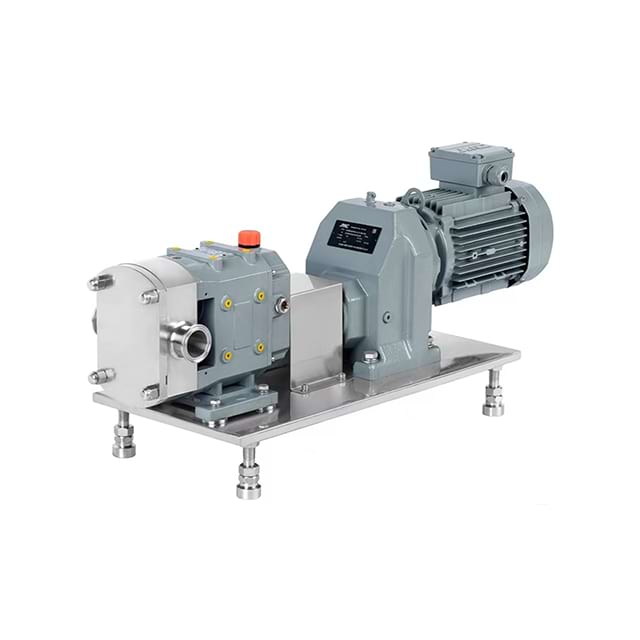
Positive displacement pumps capture a specific volume of fluid. They physically move this fluid from the suction side to the discharge side. They do not rely on kinetic energy. This makes them highly versatile.
Rotary Lobe / Circumferential Piston: These models are ideal for high-viscosity, shear-sensitive fluids. Think of yogurt, chocolate, and heavy batters. They maintain consistent flow regardless of system backpressure. Circumferential piston models offer longer sealing paths. This reduces internal slip.
Air-Operated Double Diaphragm (AODD): These pumps excel in explosive environments. They provide excellent self-priming capabilities. You can easily move them around a facility. Caveat: They consume high volumes of compressed air over time.
Certain applications require absolute isolation or the ability to process complex fluid mixtures. Standard pumps often fail under these extreme conditions.
Liquid Ring Pumps: These units handle aerated fluids perfectly. They will not lose prime when processing foam. This capability makes them the industry standard for CIP return applications.
Peristaltic / Eccentric Disc Pumps: These designs offer zero cross-contamination risk. The fluid only touches the internal hose or tube. They are ideal for live-cell biopharma processing. They also excel at shear-critical dosing. Caveat: Eccentric disc pumps typically cannot pump pure water due to lubrication requirements.
Pump Type | Max Recommended Viscosity | Shear Sensitivity | Ideal Application |
|---|---|---|---|
Centrifugal | ~200 cPs | High (Damages fragile fluids) | Milk, Beer, Water |
Rotary Lobe (PD) | 100,000+ cPs | Low (Protects structure) | Yogurt, Chocolate |
Liquid Ring | Low | Moderate | CIP Return (Foamy fluids) |
Peristaltic | High | Extremely Low | Live-cell Biopharma |
Proper sizing requires a systematic approach. You cannot simply guess a pump's required horsepower. We use a four-dimensional framework to eliminate sizing errors. This methodology guarantees a precise equipment match.
You must establish strict hydraulic boundaries before looking at pump catalogs. These numbers form the foundation of your specification.
Identify flow rates: Pinpoint your minimum, normal, and maximum flow rates. Do not size a pump exclusively for an unlikely maximum flow. Focus on your normal operating conditions.
Establish discharge pressure limits: Calculate the pressure required to push fluid through your system. Sanitary piping generally withstands 75 to 3,000 psi. Always verify your pipe rating before selecting a high-pressure PD pump.
Maintain optimal fluid velocity: Keep fluid velocity at or below standard recommendations. We suggest a maximum of 5 ft/sec. Higher velocities create friction, cause water hammer, and overload the system.
The fluid itself dictates the mechanical design of the pump cavity. Ignoring fluid properties guarantees premature failure.
Viscosity & Shear Sensitivity: As discussed, this determines your pump category. You must choose between Centrifugal and PD technologies based on these numbers. Newtonian fluids behave differently than non-Newtonian fluids under stress.
Particulates: Identify if your fluid contains solids. Crushable solids require different handling than non-crushable solids. Hard particulates demand specific internal cavity clearances to prevent jamming.
Vapor Pressure: Check the vapor pressure against your suction conditions. If localized pressure drops below the vapor pressure, the fluid boils. This causes cavitation, which quickly destroys impellers and casings.
Thermal dynamics play a massive role in sanitary processing. Facilities often process products at room temperature but clean equipment using near-boiling chemicals.
Map out extreme temperature differentials between standard operations and CIP/SIP (Sterilize-in-Place) cycles. You must anticipate how metals react to heat.
Implementation Risk: Stainless steel expands predictably under high heat. Positive displacement pumps operate using incredibly tight internal clearances. If you run hot CIP fluids through standard rotors, the metal will expand and contact the casing. This causes galling. To prevent this, you must specify undersized rotors. They provide enough clearance to safely absorb thermal expansion.
Best Practice: Always provide your vendor with your maximum CIP temperature. Do not just provide your daily operating temperature.
Pumps do not exist in isolation. The surrounding pipework heavily influences their performance. Map the exact piping route. Account for elevation changes, elbows, and sanitary valves. This lets you accurately calculate friction loss.
Furthermore, you must integrate pump suction calculations with your existing Tank Components. Bottom-mount valves and sight glasses affect how fluid enters the suction line. Proper integration ensures smooth fluid entry. It also prevents unwanted air entrainment, which can cause vapor lock or unpredictable flow variations.
Sanitary environments demand rigorous hygiene. You cannot compromise on cleanability. An improperly designed pump becomes a breeding ground for dangerous bacteria.
Always verify your equipment meets necessary localized and industry frameworks. Never take a manufacturer's word for "food grade" without seeing documentation.
3A Sanitary Standards: Widely recognized in the dairy and food sectors. 3A requires specific surface finishes (often 32 Ra or better). It also mandates generous internal radii to eliminate bacterial traps.
FDA Compliance: All elastomers must utilize FDA-approved materials. This ensures no toxic compounds leach into your product.
USDA Compliance: Critical for meat and poultry processing. USDA standards often require rapid teardown capabilities.
Determine how your facility prefers to clean its equipment. This operational choice heavily influences your pump selection.
Determine if the pump design allows for continuous Clean-in-Place. A true CIP pump requires no manual teardown. It cleans itself via turbulent flow and chemical circulation. Alternatively, some processes necessitate Clean-Out-of-Place (COP). This requires technicians to manually disassemble the wet end.
Evaluate draining capabilities carefully. Pumps must drain fully between batches. Any residual fluid creates a risk of bacterial pooling. Look for pump casings featuring bottom-drain ports or specific mounting angles.
The mechanical seal is often the weakest link in any pump system. Fluid properties dictate your seal strategy.
Sticky or abrasive fluids destroy standard single mechanical seals. If you process caramel or sugary syrups, you need specialized seal face materials. You will often require forced seal flushes. A flush introduces a secondary liquid (like water) to clean and cool the seal faces. This prevents sugar crystallization.
Evaluate the pump’s physical design for maintenance access. Prioritize models featuring front-loaded product seals. This design allows technicians to replace seals simply by removing the front cover. They do not have to disconnect the pump from the main process piping. This saves hours of labor.
Do not contact vendors with vague requests. Sending an email asking for a "milk pump" yields inaccurate quotes. You must control the specification process.
Provide vendors with hard, calculated data. This proves your engineering rigor. It also holds the supplier accountable for their recommendations. Consolidate the following metrics:
Exact fluid viscosity at the actual operating temperature. (Viscosity changes drastically with temperature).
Specific gravity or density of the product.
Calculated Net Positive Suction Head available (NPSHa).
Required flow rate.
Calculated discharge pressure. This must include all piping friction losses.
Once you distribute your data packet, evaluate how vendors respond. Their engineering logic reveals their true capabilities.
Performance Curves: Do they offer performance curves specific to your fluid's viscosity? A water curve is useless if you are pumping heavy syrup.
Drive Sizing: Do they provide transparent sizing logic for their motor? Can they justify their variable frequency drive (VFD) recommendations based on your flow range?
System Integration: Can they supply compatible hygienic fittings? Ask if they provide auxiliary Tank Components. Sourcing your pump and tank connections from a single vendor ensures system-wide compliance and prevents connection mismatches.
Selecting a sanitary pump requires moving beyond basic flow rate requirements. You must thoroughly analyze fluid rheology, thermal expansion risks, and strict cleanability standards. A well-specified pump protects your product structure. It also ensures seamless compliance during regulatory audits.
Start by compiling your process data into a standardized specification sheet. Document your exact viscosity, operating temperatures, and piping topography. Use this detailed data to challenge suppliers on their specific pump curves. Review their proposed seal maintenance procedures critically before finalizing any purchase order. Taking these calculated steps guarantees you install a reliable, high-performance hygienic system.
A: While specific pump designs vary, centrifugal pumps generally experience a severe drop in efficiency and risk overheating when processing fluids above 100 to 200 cPs. At this threshold, a positive displacement pump becomes the necessary standard.
A: Cavitation occurs when the fluid pressure drops below its vapor pressure, creating bubbles that implode and erode metal components. It is resolved by increasing the Net Positive Suction Head available (NPSHa)—usually by raising the supply tank level, enlarging the suction piping, or lowering the fluid temperature.
A: Liquid ring pumps are typically the most reliable choice for CIP return lines. Unlike standard centrifugal pumps, they can handle fluids containing high amounts of entrained air (foam) without losing their prime.
A: In high-temperature processes or during hot CIP cycles, metal rotors expand. Because PD pumps operate with extremely tight internal clearances to maintain efficiency, undersized rotors are specified to compensate for thermal expansion and prevent the metal from galling or seizing against the pump casing.